
Guitar Magazine October Issue
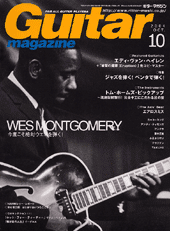
Guitar Magazine features a special on Wes Montgomery, marking his second appearance on the cover since August 1993. It’s undeniable that Wes’s presence remains indispensable in the guitar world, transcending genres.
Kiyohito Koizumi, who possesses extensive knowledge about Wes Montgomery and his playing techniques, meticulously details “The Life of Wes Montgomery.” However, I felt compelled to address a minor disagreement regarding the “Equipment Loved by Wes” as noted by the editorial team.
Firstly, it mentions, “It seems he also owned a ‘L-5CES in Natural Finish (the guitar depicted on the ‘Full House’ jacket).” However, as previously explained on this site, this was a promotional shot and not Wes’s guitar.
Additionally, it states, “Gibson ‘ES-175,’ although indeterminable from the published photos, this guitar with 19 frets and a single ‘P-90 Pickup’ was a model before 1955. Later models had 20 frets and a Humbucker; Wes appeared in Gibson’s promotions in the early 1960s. This photo might have been taken for the ‘ES-175’ promotion, and Wes owned the model with the specifications before 1955. This might have hidden the last fret and pickup.”
Suppose this photo (the ‘Incredible Jazz Guitar’ jacket photo) was taken for Gibson’s promotional purposes. They wouldn’t have used the latest model. That’s why “P-90 Pickup” and fret hiding are unnecessary. I think it’s a natural pose for guitarists from the photo.
The division between 19 and 20 frets seems to be in 1955, with the “P-90 Pickup” by 1956 and the “Humbucker” by 1957.
This Gibson ‘ES-175’ also features Wes’s sound in Nat Adderley’s leading work ‘Work Song,’ as well as the other, and it is possible that five months later, Cannonball’s leading work ‘Paul Winners’ also includes Wes’s road.
The ‘Incredible Jazz Guitar’ jacket photo seems to be clearly taken for the jacket photo and is unlikely to be taken for Gibson’s promotional purposes.
I was impressed with the rare photos in this feature. Especially the performance of the Montgomery Brothers on January 23, 1961, and the frequent performances at the “Five Spot.”
Finally, sorry for mentioning the “EP” as a “Navy Swing” broadcast sound source in the “Album Guide,” but it is a 12-inch transcription LP for Navy recruiting purposes.