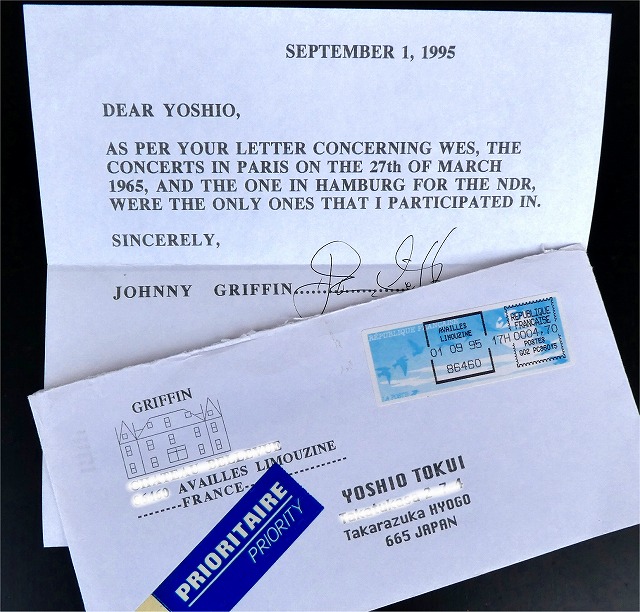
Johnny Griffin Talks About Wes Montgomery
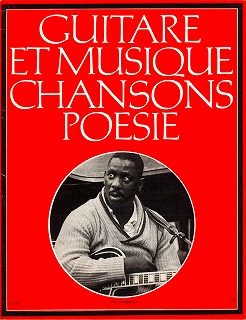
I bought a French guitar magazine because Wes Montgomery was on the cover. It was quite similar to Japanese magazines, featuring introductions to guitarists and transcriptions of their music. Inside, there was a short profile of Wes and an article where Johnny Griffin talks about him. The issue was published by Éditions Musicales Chant du Monde, No. 61, probably in October 1969.
Johnny Griffin Talks About Wes Montgomery
The first time I met Wes Montgomery was in… let me think… San Francisco. His two brothers, Monk and Buddy, came to listen to us as well. At that time, I was playing with two other guitarists, George Freeman and Leo Blevins, both of whom were extremely talented. What I remember from that first meeting was the night itself. I was playing intensely and didn’t have much time to talk to Wes. But soon we became close friends. Wes and his brothers lived in the area where we were playing and would often come to jam with us (“Le Bœuf” as they called it).
When I left Thelonious Monk’s band in 1959, I truly realized Wes’s brilliance as a guitarist. Wes Montgomery was an amazing person. He didn’t drink alcohol or smoke cigarettes (though it’s not clear if he refrained from smoking out of respect for Griffin or if he started smoking later). He was used to homemade food from his mother and wouldn’t eat things like frog legs or snails, even when he was in France.
Wes had seven children and was a model father. He spoke slowly and thoughtfully, never saying unnecessary things, but had an excellent sense of humor. He would often start little stories that no one realized were jokes at first, leading to everyone laughing heartily at his wonderful humor.
As I mentioned before, Wes Montgomery was a serious type. He didn’t get overly excited, didn’t drink, rarely went to small clubs where we would usually hang out, and never showed off in front of women. He always dressed neatly, but due to his somewhat sausage-like body shape, his jacket buttons… well, but he always had a smile.
During our time in San Francisco, we saw each other frequently. Sometimes when I planned to go see Wes’s performance, Wes would come to listen to my playing instead. Occasionally, I would have a modest meal with “Pointeur” (a term for a skilled musician), but Wes often invited me to dinner at his home.
Wes’s sense of rhythm and tempo, his intuition for melody and harmony, were astonishing. What was incredible was that he learned all this on his own. His creativity was exceptional, making every play perfect. There’s nothing more to say.
I will never forget the recording session with Wes and the strings orchestra at Riverside Records. That day, he played as if possessed, especially during a beautiful ballad recording. All the “Premier” musicians (those who play bowed string instruments like violins, violas, and cellos) naturally stood up and gave Wes a standing ovation. It was amazing. (Note: During the recording of “FUSION! Riverside RM-472,” producer Orrin Keepnews, while taking a walk near Rockefeller Center during a break, invited Horace Silver to watch the session, but Griffin wasn’t participating in the recording and was likely just observing).
The first time I worked with Wes was at a recording session at “Coffee House Tsubo” in Berkeley, across from San Francisco. At that time, San Francisco had Wes and his brothers, myself (performing at “Jazz Workshop”), and the Miles Davis Sextet with the formidable rhythm section of Wynton Kelly, Paul Chambers, and Jimmy Cobb playing at “Black Hawk.” Oren Keepnews, vice president of Riverside Records, wanted to do a live recording session. On June 25, 1962 (my and Miles’s day off), Wes, Wynton Kelly, Paul Chambers, Jimmy Cobb, and I performed with high energy in front of an audience at “Coffee House Tsubo,” and this was recorded on “Full House Riverside RLP-434.”
The last time I played with Wes was in 1965 during a European tour organized by Alan Bates. There were concerts at the North German Broadcasting Station (NDR) in Hamburg, a concert in the Netherlands (though this may be misremembered as there’s no recording from this concert), and, of course, the well-known concert in Paris.
Hearing about Wes’s death was a tremendous shock. A man who did nothing wrong, dying of a heart attack at the peak of his life. Fortunately, records will faithfully preserve his wonderful music.
Interview and translation by Maurice Cullaz
Notes:
The recording referenced is “Full House Riverside RLP-434.”
“Le Bœuf” refers to jam sessions.
“Pointeur” refers to an excellent musician.
“Premier” refers to musicians who play bowed string instruments.