
The Mysteries of the Unissued and Unedited Full House
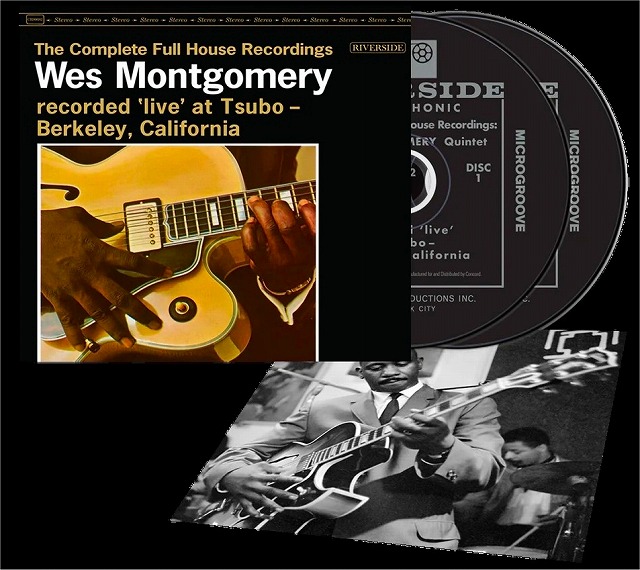
《The Complete Full House Recordings/Craft Recordings CR00682》
In November, Craft Recordings released an expanded edition titled “The Complete Full House Recordings/CR00682” to commemorate Wes Montgomery’s 100th birthday. This 2-CD set (with a 3-LP set to be released later) compiles the entire session at “Coffee House Tsubo.” The collection includes the original six tracks from the album “Full House/Riverside RLP-434,” three tracks from “The Alternative/Milestone M-47065″—namely, “Come Rain Or Come Shine-take 1,” “S.O.S.-take 2,” and “Born To Be Blue-take 2″—and three tracks from “The Complete Riverside Recordings/Riverside 12RCD-4408-2”: “Blue ‘N’ Boogie-take 1,” “Cariba-take 1,” and “Born To Be Blue-take 1.” The highlight of the album is the previously unreleased takes of “Full House” and “S.O.S,” totaling 14 tracks.
The liner notes include photos that convey the atmosphere of “Coffee House Tsubo,” but intriguingly, a short comment by the producer on the back cover addresses the original album take and the unreleased take of “Full House.”
“The original album take of ‘Full House’ on Disc 1 was a composite of two takes, with Wes’s guitar solo taken from a different take. However, the ‘Full House’ on Disc 2 is a complete master take with Wes’s original solo restored,” the promotional note teases. (In simple terms, it means they found what should have been the original album take.)
Upon hearing this, I re-listened to the familiar original album take of “Full House” but couldn’t detect any signs of compositing or editing; it sounded musically perfect. In those days, combining two takes meant physically cutting and splicing analog tapes, which would usually leave some trace or create some sense of discontinuity in the performance. If it was indeed a composite, it was a “divine composite.”
The previously unreleased “Full House” on Disc 2, at 7 minutes and 22 seconds, is noticeably shorter than the original album take of 9 minutes and 18 seconds. “Full House,” composed by Wes in F minor 3/4 time, breaks down as follows:
- Original Album Take (9 minutes, 18 seconds):
- Intro
- Theme
- Wes’s solo (3 choruses)
- Griffin’s solo (2 choruses)
- Kelly’s solo (2 choruses)
- Theme
- Outro
- Unedited, Unreleased Take (7 minutes, 22 seconds):
- Intro
- Theme
- Wes’s solo (1 chorus)
- Griffin’s solo (2 choruses)
- Kelly’s solo (2 choruses)
- Theme
- Outro
Listening to the unreleased take, I immediately noticed some oddities:
- Wes’s solo ends after just one chorus, unlike the original album take, which features three choruses. Why?
- Griffin’s tone is audible for about two seconds at the start of Wes’s solo. Why?
- The last note of Wes’s solo doesn’t follow naturally from the preceding phrase. Why?
Points 2 and 3 suggest that the take, advertised as “unedited,” might actually be edited, as it feels highly unnatural. Apart from Wes’s solo, the intro, theme, Griffin’s solo, Kelly’s solo, theme, and outro are identical to the original album take. This implies that the familiar original album take was the true unedited take, while the unreleased take is a composite/edit with Wes’s solo replaced by a different take. In other words, the one-chorus solo part in the unreleased take (7 minutes, 22 seconds) likely exists as a separate take.
The mystery of when and how this editing occurred remains unsolved, be it at Craft Recordings or earlier at Riverside Records. In the absence of concrete evidence, I cannot add this unreleased take to the discography.
Aside from the editing mystery, another highlight of “The Complete Full House” is “S.O.S. take-1,” a genuinely unreleased take. Though it wasn’t included in the 12-CD set “The Complete Riverside Recordings/Riverside 12RCD-4408-2,” Craft Recordings deserves praise for discovering it if they did.
Bill Milkowski’s liner notes summarize it: “In the previously unreleased ‘S.O.S. take-1,’ Griffin makes a slight mistake at the beginning but delivers a fiery solo. Wes’s solo is pure single-note playing, avoiding octaves and chordal work. Kelly’s piano solo is swinging but slightly subdued in volume. Chambers’ superb walking bass line is impressive, and Cobb’s drum solo in the four-bar exchange is energetic and hip. Despite its power, this take wasn’t chosen by Keepnews due to its flaws.”
“S.O.S. take-2,” released on “Alternative Wes Montgomery/Milestone M-47065,” features a confident performance from all, with Griffin playing intensely from the start. Wes’s solo is smooth but lacks the razor-sharp edge, more like a solid double rather than a home run. Kelly’s solo is hot, followed by a dynamic four-bar exchange between Griffin, Cobb, and Wes. Despite this, I prefer the take on the original album, and Keepnews made the right choice.”
The non-alcoholic “Coffee House Tsubo,” located at 2901 Telegraph Avenue, Berkeley, a mile from the University of California, opened in 1961. Wes, after moving to the West Coast with his family, reported to Keepnews about a regular Monday gig with his brothers at a coffee house in Berkeley. On June 25, 1962, at this familiar stage, Wes had a fateful live session with the Wynton Kelly Trio and Johnny Griffin. Keepnews recalled, “We rehearsed seven songs in the afternoon, aiming for 2-3 takes each. Wally Heider, a skilled live recording engineer, ensured everything went smoothly.” (Note: The seventh song, “Born To Be Blue,” wasn’t included in the original album due to a failed ending that caused laughter among the members.)
Milkowski added, “The ‘Coffee House Tsubo’ closed on October 15, 1962, just four months after this recording session.” An Oakland Tribune column on October 21, 1962, reported the closure, lamenting the loss of a clean, comfortable American jazz room that met community needs, allowing underage patrons.
On December 2, Keepnews shared more memories: “Since Wes was in San Francisco, I planned a live recording at ‘Coffee House Tsubo’ and contacted Wynton Kelly, who was performing with Miles Davis at the ‘Black Hawk.’ The lineup included Paul Chambers on bass and Jimmy Cobb on drums. Kelly responded, ‘Miles is furious and refuses to participate,’ as I had apparently requested Miles’s participation, and he refused.”
The July 19, 1962 issue of DownBeat magazine noted Wes’s successful session with Johnny Griffin at the “Coffee House Tsubo” on June 24 and 25. Though the June 24 session was likely not recorded, Wes continued performing the following week, but details about the members and recordings are unknown. The Montgomery Brothers had disbanded in April.
(Note: It’s not surprising that unedited or composite takes like those labeled “B” or “C” exist, given the practice of retaining even discarded takes.)