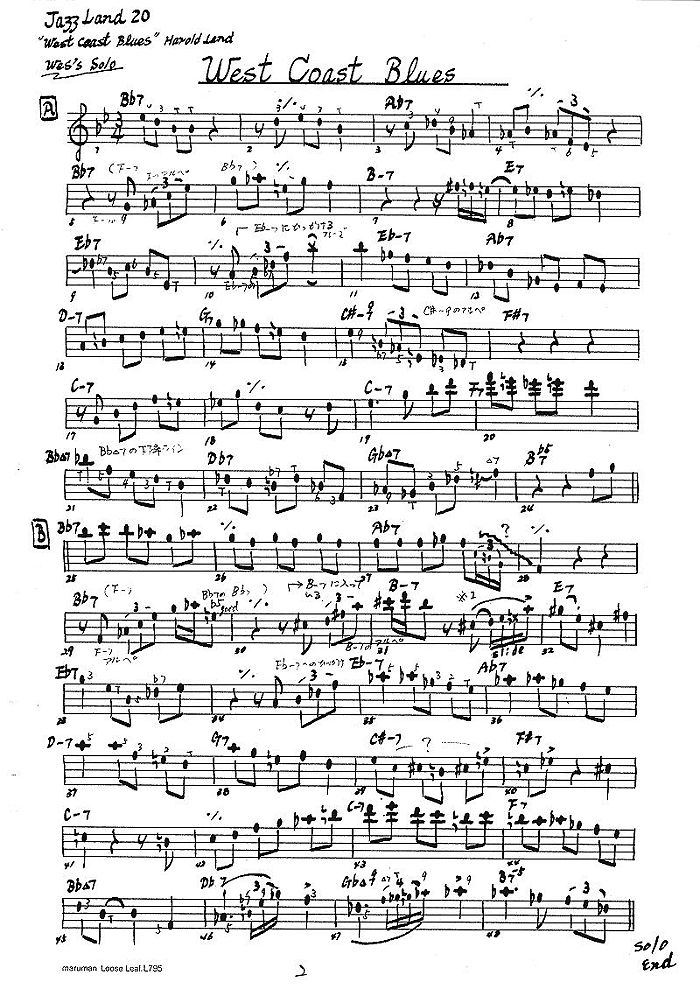
WEST COAST BLUES (Transcribed by GIBSON BOY)
In April 1960, the jazz guitar masterpiece The Incredible Jazz Guitar of Wes Montgomery was released, marking the official debut of this song. Since then, it has been featured as one of Wes’s beloved pieces on albums and VTRs no less than seven times (eight if including the theme from 625). (For more details, please refer to the “Wes’s Compositions” section in the discography on our website.)
The version of this track that we have copied is Wes’s improvised solo from Harold Land’s WEST COAST BLUES/JAZZLAND JLP-20, which has not been published in books or magazines before. This Blues number, among many composed by Wes, contains several characteristics unique to him. It features a particularly significant and memorable melody. With its melodic and waltz-time (3/4) rhythm, it is a bright and appealing melody that one might want to hum along to, offering a different color from traditional Blues.
Thus, it has been performed by other players as well, such as Cannonball Adderley and Nancy Wilson, and can be considered one of his representative and great works.
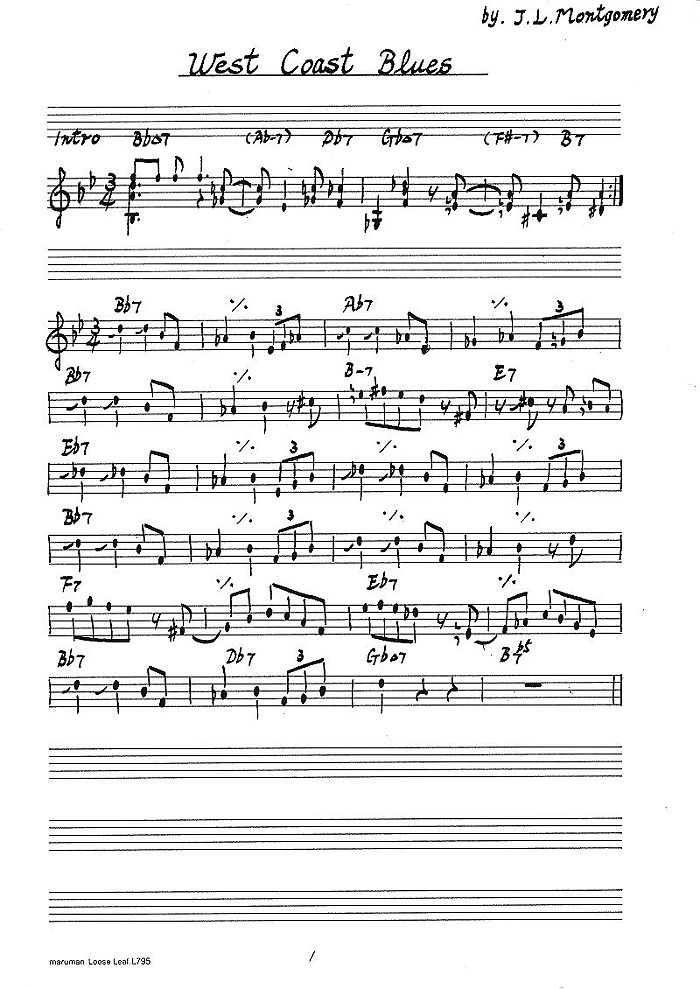
Wes’s technical features are also well represented. First, the piece is structured in 24 bars of waltz time (interpreted as 2 bars for each usual Blues bar). It is in the key of B♭. The chord progression of the theme is not much different from a standard Blues progression, but the improvisational part uses many II–V progressions to create a smoother flow (bars 11–20 of the improv section). Here, the half-step descending line from A♭7 to F7 is divided into II–V to enhance smoothness. Wes often breaks down the V7 into II–V in his solos. Additionally, one of Wes’s most notable characteristics, the use of substitute chords (creating an “outside” feel), is evident. This is seen in the use of a flat-V7 substitute chord before moving to IV7 (E♭7), further broken down into II–V progressions. This is present in bars 7–8 with Bm7/E7. Also, the final turn-back of the chorus (bars 20–24) utilizes substitute chords to create a very pleasing progression. Normally, one would use B♭7–G7–Cm7–F7 (I7–VI7–IIm7–V7), but instead, it progresses as B♭maj7–D♭7–G♭maj7–B7♭5, a fourth progression with substituted chords. For reference, the intro and ending (which are not played in this version) also follow this progression.
Below is a detailed analysis of how Wes applies musically rational and correct techniques, broken down by measure.
WES AD-LIB SOLO Analyze
[A]
- Bars 1–2: B♭7 – Simple use of T, 3°, 4°, expressing the tonic 7th.
- Bars 3–4: A♭7, a whole step down – Simple use of 3°, 4°, T to express A♭7.
- Bars 5–6: B♭7 divided into Fm7–B♭7 as II–V, starting with an Fm9 arpeggio from the 9th. A common Wes technique.
- Bars 7–8: Wes’s specialty in substitute chords. While B♭7 would suffice, E7 (a substitute for B♭7) is used and further divided into Bm7–E7 (II–V) to create an “outside” feel. The chord progression resolves to E♭7 with a half-step.
- Bar 9: E♭7 (IV7) – A simple yet perfect 7th feeling phrase with Mix-Lyd ♭7, 5°, 6°, 5°, T.
- Bar 10: Though typically an E♭7 progression, Wes anticipates moving to E♭m7–A♭7 by already playing a phrase that hints at E♭m7.
- Bars 11–12: A transformation of the E♭m7–A♭7 arpeggio with a clean descending line.
- Bars 13–14: Dm7–G7 – A clean ascending line starting from the 5th of Dm7.
- Bar 15: A descending line from C#m9 arpeggio. A phrase Wes is known for.
- Bars 21–24: Impressive performance of B♭maj7–D♭7–G♭maj7–B7♭5. The progression is expressed perfectly.
- B♭maj7 (T, 5, 4, 3, T)
- D♭7 (T, ♭7, T, 6, 3)
- G♭maj7 (9, T, 3, 5, Mj7) This progression is a variation of B♭7–G7–Cm7–F7 (I7–VI7–IIm7–V7) as previously described.
[B]
Bars 45–48: As with bars 21–24, B♭maj7–D♭7–G♭maj7–B7♭5 is perfectly executed.
Bar 29: Consider B♭7 as Fm7–B♭7, with Fm7 arpeggio. The final E note uses B♭7’s ♭5, making it very hip.
Bar 30: Anticipating Bm7–E7 in bar 31, with Bm7 arpeggio already played.
Bar 31: *1 is a nuance note, with Bm7 arpeggio.
Bar 33: The E♭7 (IV7) phrase is simple but stylish, with a structure of 3, T, 5, ♭7, T.
Bars 34–38: E♭m7–A♭7, Dm7–G7, similar phrase patterns.
GIBSON BOY