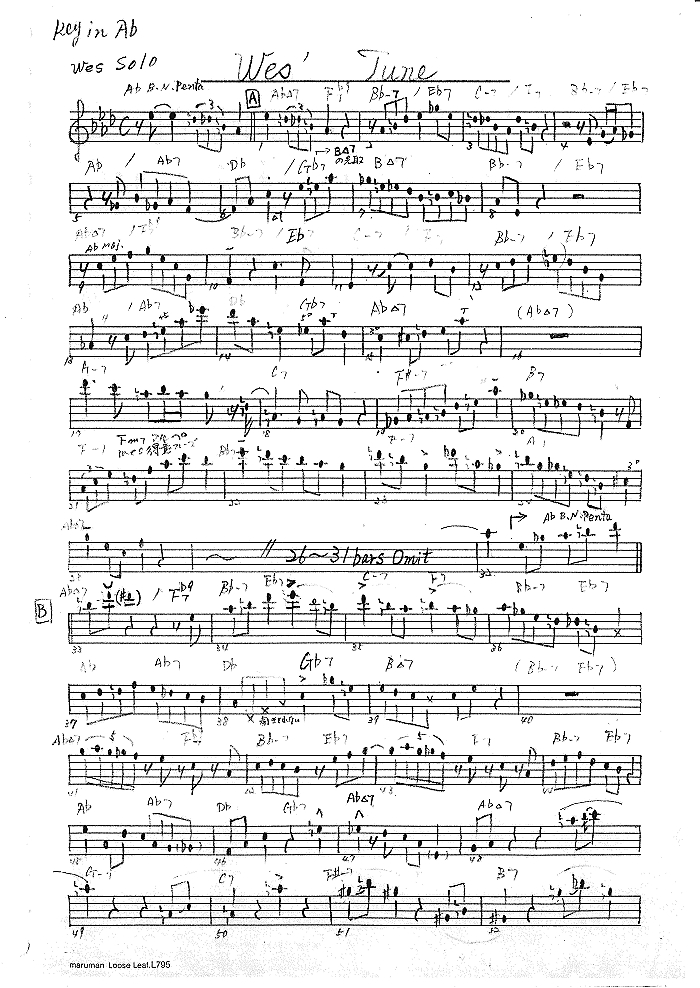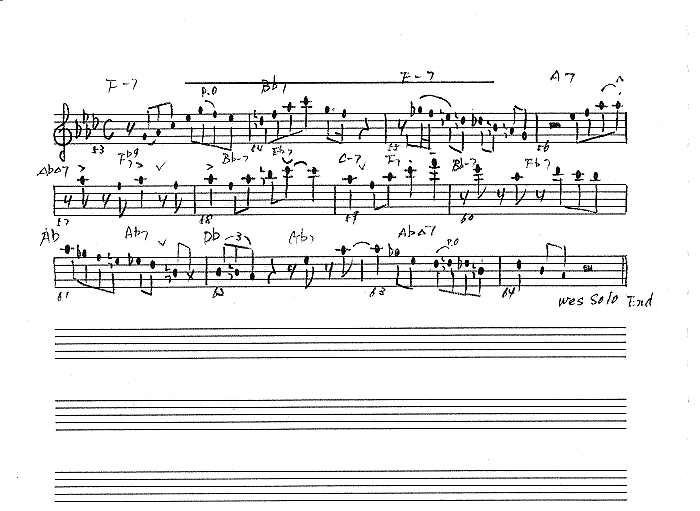
Wes’ Tune(Transcribed by GIBSON BOY)
This time, we bring you the transcription of Wes’s original piece “Wes’ Tune” from Montgomeryland/Pacific Jazz PJ-5. This piece follows the Rhythm Change (I Got Rhythm), which is second only to Blues in jazz performance styles, incorporating cadences like I-Ⅵ7-Ⅱm7-Ⅴ7 and I-I7-Ⅵ-(Ⅵm7). Let’s analyze the theme and ad-lib transcription. The phrases in key parts truly showcase Wes’s brilliance, and they will be very instructive!
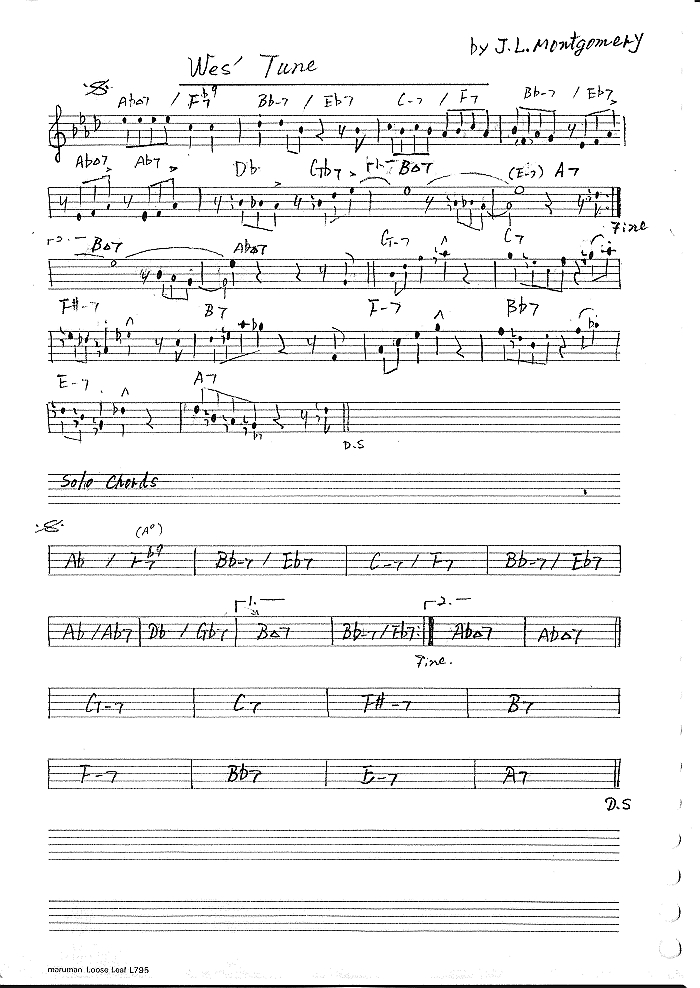
Theme “Wes’ Tune” is a 32-bar piece in A-A-B-A form, set in the key of A♭. Wes adds a unique twist to the typical Rhythm Change chord progression. Let’s take a look at these sections. In the theme’s chord progression, the seventh measure is BMaj7. Instead of ending on A♭Maj7, he places G♭7 on the 3rd and 4th beats of the 6th measure, resolving to BMaj7, creating a sense of openness.
In the ad-lib section, this part has two variations:
- The first time (7th and 8th measures) is BMaj7 | B♭m7 – E♭7 |
- The second time (15th and 16th measures) is A♭Maj7 | A♭Maj7 | (refer to the solo chord changes).
In the bridge, instead of the typical Ⅴ7 progression by fourths, there is a chromatic descending progression of Ⅴ7 chords, with Wes further breaking down the Ⅴ7 into Ⅱm7-Ⅴ7, his specialty. The theme melody here is based on the arpeggios of each chord but crafted rhythmically and melodically so they don’t sound like mere arpeggios.
Ad-lib Analysis Before we dive into Wes’s ad-lib solo analysis, let’s consider some methodologies for ad-libbing in the Rhythm Change style.
- Follow the progression strictly, changing chords every two beats (e.g., I-Ⅵ7-Ⅱm7-Ⅴ7 | Ⅲm7-Ⅵ7-Ⅱm7-Ⅴ7 or I-I7-Ⅵ-Ⅵm7), creating a sense of movement with each chord change.
- Use the A♭ blues scale for the first 4 or 8 bars, taking a solo with blues phrases.
- Incorporate tricky unit phrases that move mechanically by augmented fourths or take a more free-form solo approach.
Many combine these approaches, sometimes strictly following the chord progression (like Joe Pass), using bluesy phrases, or incorporating tricky phrases for variation.
Now, let’s analyze Wes’s ad-lib solo:
[A] From 1 bar before the start to the 3rd measure: He hooks the ad-lib phrase from 1 bar before the solo section and plays a blues pentatonic phrase in A♭ through the 3rd measure.
[A] From the 9th to the 12th measure: A beautifully sung phrase that rides on the broad chord progression of I-(Ⅵ7)-Ⅱm7-Ⅴ7 | Ⅲm7-(Ⅵ7)-Ⅱm7-Ⅴ7.
[A] From the 17th to the 24th measure (the bridge): The bridge starts with a descending chromatic progression of Ⅴ7 chords, with Wes breaking down the Ⅴ7 into Ⅱm7-Ⅴ7. Wes’s signature m7 arpeggio phrases appear here.
[A] From the 32nd measure, 2nd beat to [B] 36th measure (start of the 2nd chorus): Here, he plays an A♭ blues pentatonic phrase with bends, evoking a blues feeling.
[B] From the 37th to the 39th measure: A model phrase that strictly follows the chord progression of I-I7-Ⅵ-♭Ⅶ7.
[B] From the 41st to the 48th measure: My personal favorite phrase in this take, it’s a model phrase that can be memorized and used, wonderfully sung.
[B] From the 48th measure, 4th beat to the 52nd measure (the bridge of [B]): A unit phrase descending chromatically with call and response, an attention-grabbing phrase.
[B] From the 56th measure, 3rd and 4th beats to the 60th measure: This phrase is also superb. It evokes the essence of Be-Bop, similar to what Charlie Christian would play.
GIBSON BOY