Doujie(Transcribed by GIBSON BOY)
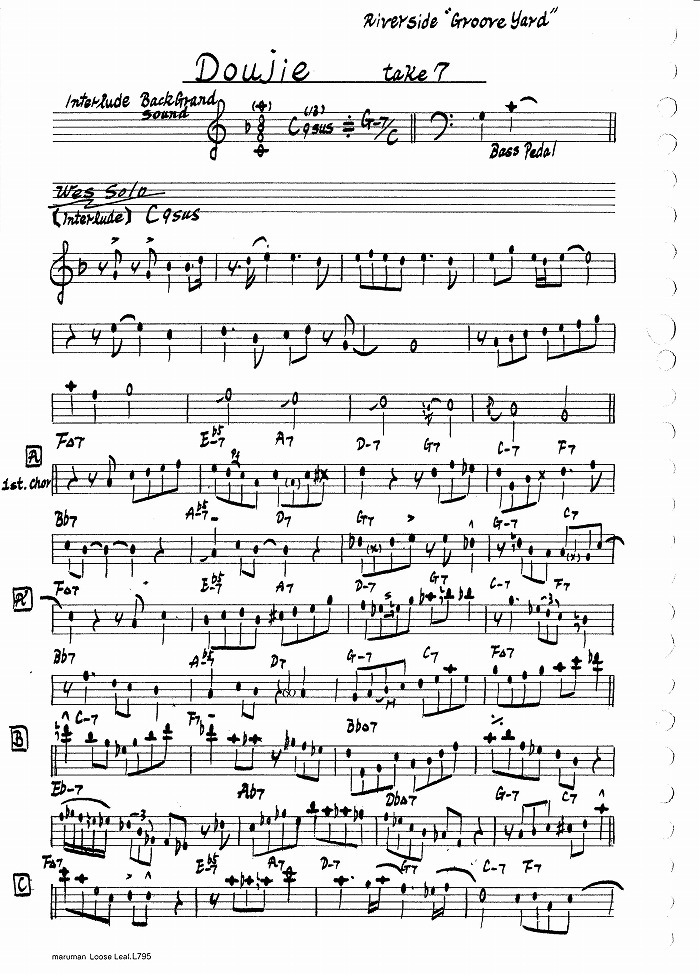
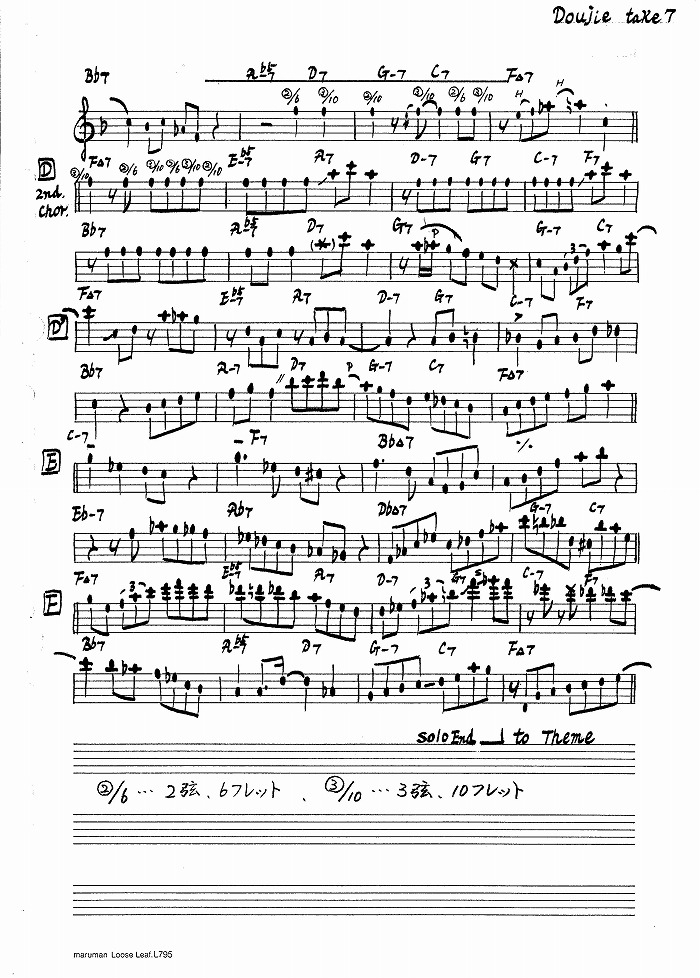
For this eighth transcription, I’ve transcribed Take-7 of “Doujie.” Many of you might think, “Hey, this chord progression sounds familiar…” when you listen to this piece. That’s right! The chord progression is exactly the same as Charlie Parker’s “Confirmation.” Wes composed “Doujie” based on this chord progression, making it essentially Wes’s “Confirmation.” One of the charms of this piece lies in its very pleasing chord progression. The continuous II-V progressions, characteristic of Bebop’s subdivided two-beat changes and fourth progressions, make the ad-lib solos an excellent study of Bebop language. Wes’s interpretation and realization of Bebop language can be traced through this piece.
Interlude A 12-bar interlude is inserted between the theme and solo, and between solos. Here, the backing has a C9sus sound with a pedal point. This sound shapes the beginning of the solo, leading into the F△7 at the start.
- Wes plays this part with a Gm7-C7 feel in his solo.
Ad-lib Solo The solo over the theme’s chord progression starts with the first 5 bars, moving from I△7 to the parallel minor II m7♭5 – V7 progression. The 5th bar sees the IV7 interpreted as a tonic 7th, resolving into a II-V-I progression. This progression is very satisfying; even just playing the chords brings out the melody. After that, although there are some unusual progressions, it mostly follows the III m7♭5 – VI7 – II m7 – V7 – I pattern. The bridge consists of II m7 – V7 – I in B♭ Major and II m7 – V7 – I in D♭ Major. The 5th bar of section [B] (Rehearsal Mark B) with E♭ m7(9) features one of Wes’s signature phrases using m9 arpeggios skillfully. The phrase resolving from A♭7 to D♭△7, starting with an eighth note on the 4th beat of the 5th bar, is particularly exquisite. In the 6th bar of section [C], Wes plays a hip phrase using the same F note on different strings (this phrase has a Charlie Christian vibe). This sets up the first 6 bars of the 2nd chorus in section [D], where he again uses the same F note on different strings skillfully. These phrases are incredibly groovy and captivating. Overall, this piece frequently features the II m7 – V7 – I progression. Wes’s solo is very logical, but his phrases are filled with a singing quality, making them a great study.