
Wes’s music Wes Never Played
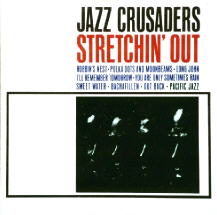
Album Name: Stretchin’ Out / The Jazz Crusaders
Album Number: Pacific Jazz PJ83
Release Country: USA
Release Year: 1963
Media: LP
The Jazz Crusaders:
Wayne Henderson(tb, euph) Wilton Felder(ts, as) Joe Sample(p), Joe Pass(g) Monk Mont-
gomery(b) Nesbert “Stix” Hooper(dr)
1963
Long John
Robbin’s Nest
You Are Only Sometime
Out Back (Composition by Wes Montgomery)
Bachafillen
I’ll Remember Tomorrow
Polka Dots And Moonbeams
Sweetwater
Whether to call them “The Crusaders” or “The Jazz Crusaders” is truly confusing. However, in 1963, while Wes was still actively performing, this group, despite the confusion, released the album “Stretchin’ Out” (Pacific PJ83), which included the rare track “Out Back” composed by Wes Montgomery, a track he himself never recorded.
I actually received this information last year from guitarist Kiyoto Koizumi but had forgotten due to my busy schedule. I am ashamed to admit that I rushed to publish it belatedly. I apologize for this oversight.
Based on the above data, I will refer to them as “The Jazz Crusaders.” I wasn’t particularly interested in their records from that era, so it was my first time listening to “Out Back.” My first impression was that it had the vibe of “Five Spot After Dark,” a minor blues by Benny Golson, which is featured on Curtis Fuller’s “Blues-ette.” The playing style is similar to the later Golson/Farmer’s “Jazztet.”
Honestly, compared to the many songs Wes left behind, this track feels overly sophisticated. However, whether due to the arrangement or other factors, it stands out as a rare gem. Nevertheless, it is unmistakably a composition by Wes Montgomery, proven by the participation of his elder brother, Monk Montgomery. It’s likely that Monk suggested recording this track because it suited the band’s style. While Joe Pass’s excellent performance is commendable, I honestly wish they had considered inviting Wes as a guest musician.
I should also briefly explain the somewhat complicated history of “The Jazz Crusaders.” The name “The Jazz Crusaders” was adopted in 1961. Before that, since their formation in 1953, they were known as “The Swingsters.” Led by Stix Hooper and consisting of Wilton Felder, Wayne Henderson, and Joe Sample, these young men from Houston, Texas, delved into a wide range of genres including jazz, blues, R&B, and gospel, with members like Hubert Laws and bassist Henry Wilson joining the mix.
In 1958, they changed their name to “The Modern Jazz Sextet” and moved to California, but failing to achieve commercial success, they returned to R&B dance band gigs under the name “Nite Hawks.” During this period, Hubert Laws pursued studies at the Juilliard School, and Henry Wilson joined another band.
Despite releasing records and achieving hits as “The Jazz Crusaders,” their financial situation did not improve, and they continued working as a dance band. In 1969, the members took a temporary break, pursuing separate paths, but in 1970, they formed a new band “The Crusaders,” incorporating R&B elements into their jazz, and released records that finally showed signs of success.
This success was likely sparked by the crossover trend ignited by Wes’s trilogy on A&M Records, which evolved into the fusion boom of the mid-70s, becoming a major phenomenon across the U.S. Some describe crossover as the fusion of classical and jazz, while fusion is the amalgamation of rock/pop and jazz.
The group gained popularity in Japan due to Joe Sample’s familiar vocal tunes and pop songs, which he played extensively. To distinguish their sound, they coined the term “Gulf Coast Sound” and started incorporating electric piano, with Wilton Felder switching from saxophone to electric bass. However, backlash against disco music eventually pushed them out of the spotlight, and by the 80s, with member departures, they faded away. In 1995, they revived the band name “The Jazz Crusaders” and released an album, though without the popular Joe Sample.
The new “Jazz Crusaders” performed in Japan at venues like Ebisu Garden Hall in 1996 and the Monterey Jazz Festival in 1998, memories still fresh in our minds.
The most regrettable loss is Wes’s passing. If he had been active in the 70s, he would have undoubtedly visited Japan and become the biggest star of the fusion boom. Joe Zawinul’s “Weather Report,” Chick Corea’s “Return to Forever,” and Grover Washington, who built the fusion sound, would have paled in comparison. But as the saying goes, “Don’t count the age of the deceased!” It’s all a fleeting dream or illusion… let’s consider it a pleasant dream.