
The Tale of the Youthful Go-Go (55-Year-Old) Ticket
This story is titled in reference to JR’s (Japan Railway) Youth 18 Ticket, but in my case, it’s my first-ever tour of Tokyo at the age of 55. It was a mix of embarrassment and excitement. “Is this your first time?” “Well, I’ve passed through before,” I’d lamely explain, but it truly was an enjoyable 4-day, 3-night trip.
Thursday, February 14th: Clear Skies
I couldn’t fall asleep the night before, tossing and turning in bed while planning the itinerary until around 2 AM. The alarm buzzed sharply at 8 AM, and I hurriedly bit into a piece of toast and sipped black coffee before dashing out the door. I arrived at Shin-Osaka Station on a packed commuter train just before 10 AM. I was supposed to be in Tokyo by 1 PM, but unfamiliar with the Shinkansen, I ended up on the Kodama, an all-stops train, taking a full four hours to reach Tokyo.
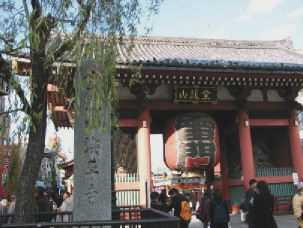
Nevertheless, I was content with this flexible, time-free schedule. With a city map in hand, I transferred trains and arrived at the much-longed-for Asakusa, which I had seen many times on TV. Passing through the Thunder Gate with its giant lantern, I walked down Nakamise Street and reached Sensoji Temple, where I quickly lit incense and prayed for a safe journey. Amidst the throngs of international tourists, I dropped my luggage at the Washington Hotel in Yokohama’s Sakuragicho and then explored the Minato Mirai 21 area as night fell. I called Aoki, the Yokohama correspondent of the Wes Fan Club, to report my arrival and discuss the plans for the next days. Despite not getting on the giant Ferris wheel due to the long line, I happily sank into bed.
Friday, February 15th: Clear Skies
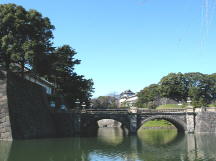
Today’s plan was to visit Kanda Jimbocho and then catch the Funky & Mellow guitarist Atsuhiko Sugimoto’s band at Lazy Bones near JR Kannai Station in the evening. First, I took the Tokyo Metro Yurakucho Line to Sakuradamon Station, toured around Edo Castle, and then headed north on Hakusan Street, passing by many second-hand bookstores. By chance, I stumbled upon Tony Records, where I had frequently found Wes Montgomery collections.

I browsed the well-organized genre shelves but couldn’t find anything I wanted, so I left after a brief search. I then reached my main destination, Adiron Duck, a jazz record specialty store near the Senshu University intersection, established just under five years ago. As I rode the elevator in the narrow building, Bill Evans’ delightful piano music played.
“Nice to meet you, I’m Tokui, who has been in touch regarding Wes.”
Surprised, the owner replied, “Oh, Mr. Tokui! Thank you for your continued support.” We chatted for about two hours, talking about our passion for records. The owner frequently travels around the U.S., acquiring “masterpieces, rare records, and oddities” to meet the demands of discerning collectors.
“These days, collectors make difficult requests, so it’s really tough,” he said, striving to survive despite the economic downturn. I’m one of those demanding collectors myself, so I couldn’t criticize others. I finally received the SP records I had requested for five years, including Wes’s credited Decca records from his Hampton days. As I admired the pristine Betty Carter vocal on “The Hucklebuck/Decca 74897” on the turntable, I mused about Wes’s involvement, getting emotional.
“Betty has surprisingly many fans, and collectors want this SP record, but since Wes is credited, you can’t part with it, right?”
“Of course, I can’t give it up,” I replied, thinking of how precious this record was. As we discussed, the owner asked, “By the way, did you know there’s a William Claxton photo exhibition at Shibuya Parco right now? If you’re interested, you should check it out—it’s just a short subway ride away.”
Packing up the SP records quickly, I headed to Shibuya. The streets were bustling with more people than in Osaka, making progress slow and frustrating. I finally found Parco Building 1. Descending the stairs, I reached the entrance where several people were buying tickets. The exhibition featured about 30 black-and-white photos, including images of Chet Baker, Art Pepper, Hampton Hawes, and Barney Kessel, which had been used on Pacific and Contemporary Records album covers. There were also photos of jazz giants like Monk, Coltrane, and Miles.
The first photo that caught my eye was the alluring cover of “Kismet/World Pacific WP-1243” by the Mastersounds featuring Wes, another Claxton work. However, Wes himself was nowhere to be found, which was a bit disappointing, but I hadn’t expected much. At 6 PM, I met up with Aoki at the Washington Hotel in Kannai. Our first-time meeting was marked by a heartfelt handshake and mutual introductions.
Aoki guided me around the famous jazz clubs in the Isezakicho area, including “Drunk Earl” and “Airgin,” where Miyajima’s performance had been canceled the previous day. We enjoyed a welcome dinner at “Shoseien,” a Cantonese restaurant. We had planned to see Miyajima’s performance yesterday, but “due to double booking, it was truly regrettable,” Aoki apologized, even though it wasn’t his fault. We decided to save it for another time and continued chatting and drinking beer despite our full stomachs.
Aoki and I often talked about Wes via email and phone, so our conversation naturally gravitated towards Wes. Later, we headed to Lazy Bones, where Sugimoto Atsuhiko’s band was scheduled to play at 8 PM. The entrance was a bit hard to find, but once inside, the cozy and quiet venue had Sugimoto and his band already waiting. The owner showed us to the best reserved seats.
“Sugimoto-san, I’m Tokui,” I greeted.
“Oh, Tokui-san, I’ve been expecting you,” he responded warmly. After introducing Aoki, a fellow Yokohama resident and Wes fan, we chatted briefly before the first set began. The band members tuned their instruments.
“Sugimoto-san, please play some Wes numbers tonight,” I requested.
“Since we’re not an acoustic band, I can’t promise everything, but I’ll give it a try,” he smiled as he headed to the stage.
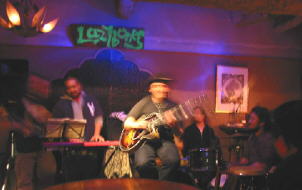
Band Members:
Atsuhiko Sugimoto (Guitar)
Makito Hoshi (Keyboards)
Hayato Osawa (E. Bass)
Koji Imamura (Drums)
Ibuki Kobayashi (Percussions)
First Stage began with Mr. Sugimoto’s original “Knock Me Out,” and midway through, they performed Wes’s original “Up and at It” from A&M’s “Down Here on the Ground” in a funky, exciting rendition.
After the first stage, we had a quick interview.
TOKUI: Well, we’ve had the pleasure of listening to your live performance, and it truly lived up to the “funky and mellow” label, wouldn’t you agree?
SUGIMOTO: Thank you very much.
TOKUI: From the theme to the improvisation, it was indeed mellow, almost made me want to start singing along.
SUGIMOTO: While there are no lyrics, I’m glad you feel that way.
TOKUI: You mentioned before that your ideal was to succeed with instrumental music, but how about trying vocals like George Benson?
SUGIMOTO: He was particularly skilled at singing… hmm.
TOKUI: Regarding your octave technique, you use your thumb like Wes, but could you demonstrate it?
SUGIMOTO: Well, it’s a bit stiff right now, which isn’t great. Ideally, it should remain soft on the outside (note: while having a hard core). Because my fingers happen to be round, they strike the strings well when I play.
AOKI: And you play with your thumb and index finger, just like holding a pick.
SUGIMOTO: When playing single tones, I sometimes use only my thumb, but most of the time, I use my index finger simultaneously.
AOKI: Oh, you use your thumb and index finger like the back of a pick.
SUGIMOTO: Yes, that’s right. In Wes’s case, the upstroke is with the thumb, so the contact is weaker, especially with classical technique, where the index finger acts like an apoyando or scratches with the nail, so by combining the fingers, the index finger can be used in a thumb-like way.
TOKUI: Oh, so in the upstroke, you use the pad of the index finger. I thought you were using a small pick or appearing to use only your thumb to play.
AOKI: So the texture of the flesh of the thumb and the index finger is the same.
SUGIMOTO: That’s right. Because of this, even with the upstroke, you can get a sound attack just like with the thumb.
AOKI: That means it’s an uncopyable playing style.
SUGIMOTO: I also used a pick at first, but once I accidentally dropped it and tried using my thumb, I found it worked quite well.
AOKI: That’s impressive.
SUGIMOTO: So I started practicing the thumb technique seriously, but I didn’t like the sound of the upstroke, so I came up with the idea of combining it with the index finger.
TOKUI: Then the movement of your right hand is different from Wes’s.
SUGIMOTO: Yes, my right hand doesn’t fix or support.
TOKUI: So you don’t really need a pickguard. You use your thumb and little finger to hold the strings, as if hooking onto the guitar.
TOKUI: I see, so with that, Sugi-san doesn’t often miss the pitches of high and low strings. By the way, what was your first experience hearing Wes?
SUGIMOTO: I think I had heard him quite some time ago, but I didn’t know Wes until I was about 23 or 24 years old.
TOKUI: Really?
SUGIMOTO: Yes, and… it was more like Takashi Matsumoto for me. I listened to George Benson, but I was a complete amateur when it came to the guitar back then… So I went to Kanda to learn jazz guitar for a while, and there was a blues song in the practice piece “Half Note”.
AOKI: “No Blues”, right?
SUGIMOTO: Yes, there were other standard songs as well, but Wes was in there. However, the first record I bought somehow had “Road Song” on it. (laughs)
TOKUI: That’s amazing, isn’t it? Well, the members are calling, so it looks like our conversation will have to pause here as the second stage begins.
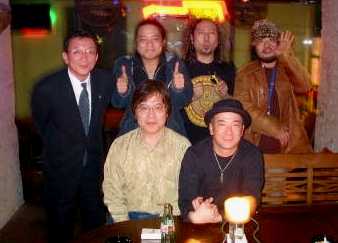
And with that, we couldn’t help but cheer and exclaim “amazing” as they crafted “Jingles” into a funk rendition for their first song. Finally, in response to Aoki-san’s request, they reached their climax with “When a Man Loves a Woman,” the hit from 1966 by soul singer Percy Sledge, and the “funky and mellow” stage of the Sugimoto Band came to a close.
AOKI: Well done, that was a fantastic ride. (Applause) Playing “Jingles” in a funk style, originally from 1959, was quite moving. I’m sure Wes up in heaven is delighted.
SUGIMOTO: I think players in the UK have played it too, but my first listen was definitely Wes’s rendition.
AOKI: Wes recorded multiple times, do you remember which era that was?
SUGIMOTO: Hmm, what was it… I’ve seen videos of Wes playing too.
AOKI: Initially, Wes played rather slowly, but over the years, his tempo picked up.
SUGIMOTO: Is that so?
The conversation continued after this, focusing solely on Mr. Sugimoto’s technique.
TOKUI: Lastly, I’d like to ask about your left-hand form; it moves so smoothly to watch.
AOKI: It’s a different movement from Mr. Miyanoue’s.
SUGIMOTO: Due to a complex fracture in my elbow, my little finger doesn’t move as freely, so I end up using my index and ring fingers to fret octaves.
AOKI: I see, your finger use didn’t change at all when moving positions. In Wes’s case, he alternates between the index and ring fingers, or the index and little fingers.
SUGIMOTO: Therefore, with a set form, it’s a matter of sliding patterns forward and backward, which inversely creates the smooth movements mentioned earlier.
TOKUI: Then, do you mute the intermediate strings with just the middle finger?
SUGIMOTO: I’m not particularly conscious of it, but it naturally turns out that way, I guess.
TOKUI: Your octaves really have a sharp edge to them; they truly are the essence of octaves. If the edge isn’t sharp, the results won’t be good in any aspect… It’s like cooking. (laughs) Well, thank you for sharing such a “funky and mellow” play tonight. I would love to come see you perform again when I have the chance. Lastly, could you sign the CD jackets for the “Funky Edition” and “Mellow Edition” of “Sugimoto Atsuhiko Greatest Hits” that I received last month?
SUGIMOTO: It’s my pleasure. Please come again.
AOKI: That was fun.
TOKUI: I apologize for keeping you so late.
AOKI: Tomorrow, I’ll guide you through the famous spots and historical sites in Yokohama. I’ll pick you up at 10 AM.
TOKUI: I’m looking forward to it. Thank you for today.
February 16 (Saturday), Clear Skies:
I had planned to meet Mr. Aoki at the hotel at 10 AM, but since I woke up early, I decided to stroll around the Odori Park area. Although I drank quite a bit last night, thanks to Mr. Sugimoto’s fantastic performance, I didn’t have a hangover.
Mr. Aoki pulled up in his beloved car in front of the hotel and greeted me with a cheerful “Good morning.” He then promptly took me on a city tour. Without a car, it would have been inconvenient to get around. We visited the Foreign Cemetery and Harbor View Park in the Yamate area, which is Yokohama’s most prestigious villa district. Afterward, we drove to Sankeien, where the plum blossoms are currently a highlight. However, due to heavy traffic up to the entrance, we decided to skip it and moved on to lunchtime.
After lunch, we visited Mr. Aoki’s home, where I got to see his cherished L-5CES Florentine Cutaway guitar. “Is this the guitar from ‘Movin’ Wes’?” I thought to myself. I wanted it so badly, but knowing I couldn’t play it, it would just become a decoration if I bought it. Still, it was impressive.
The main purpose of my trip was to visit the guitar specialty store “Walkin'” in Shibuya and to see the performance by “OGD” at “Full House” tonight. Mr. Aoki and I decided to take the train to Koiwa, and his wife kindly drove us to Sakuragicho Station.
Just as we were getting out of the car, I realized I had left my bag, which contained some SP records, in the trunk. Mr. Aoki tried to chase the car, but it drove away quickly, and unfortunately, he didn’t have his mobile phone with him.
We decided to visit the historic jazz cafe “Chigusa,” a place I frequented in my childhood, while we waited to get in touch with his wife. I felt terrible for the trouble caused by my forgetfulness. “Am I getting old? Sorry, Mr. Aoki,” I apologized. He graciously replied, “No worries, thanks to you, I got to introduce another famous spot.”
When we ordered coffee, we were immediately shown a list and asked for requests. Unable to straightforwardly request Wes Montgomery, I kept looking at the list until I was asked again, “Have you decided on your request?” I reflexively answered, “Could you play ‘Bags Meets Wes’?”
The sound system was so good that Mr. Aoki remarked, “The sound is recreated in a way you can’t hear at home.” He enthusiastically explained how he wanted to practice the song “Stairway to the Stars.”
Just as the record was about to end, we received a call from his wife, retrieved my bag, and headed to “Walkin’.” Due to my mistake, we didn’t arrive until after 4 PM.
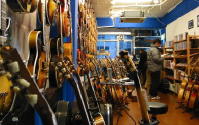
Fortunately, the store was near Shibuya Station. The young owner, Mr. Nishimura, who had been introduced via email through a special section on the old website, greeted us. Today, I wanted to hear about his trip to Indianapolis in March 1999.
"WALKIN web site"
Tokui: What was the purpose of your trip?
Nishimura: I wanted to see Wes’s cherished L-5, which is displayed at the Children’s Museum.
Tokui: It was also featured in Adrian’s book, “Wes Montgomery,” right? But did you go there just to see that guitar?
Nishimura: Yes, that’s correct.
Tokui: Sorry for the odd question, but when you really love something, there are no means or negotiations or gains, right?
Nishimura: Unfortunately, I couldn’t see it. At that time, I didn’t know who to ask, so I just returned home.
Tokui: According to an article in SJ Magazine, when critic Mr. Narita visited Wes’s widow Selene in June 1998, he explained that the guitar had been retrieved by the grandchildren. So, it must have been removed from display quite some time ago. Did you visit his grave?
Nishimura: At that time, I didn’t know about the grave either, so I just returned home. There’s nothing else around there.
Tokui: That’s too bad.
Nishimura: I went there solely to see that guitar, that was my only focus.
You really love guitars, don’t you? It was evident from his passionate talk, and the store was filled with vintage Gibson guitars.
Tokui: Which guitar is the most expensive here? Is it this heart-shaped L5 Wes model?
Nishimura: No, it’s not for sale, but it’s the D’Aquisto “Jim Hall model,” the beloved instrument of Jim Hall (Note).
Tokui: Wow, is that the guitar Jim Hall actually owned?
Nishimura: Yes, it’s on display, but it’s not for sale.
Tokui: I’m amazed. I never thought I’d encounter such a legendary guitar here.
Nishimura: Do you play guitar, Mr. Tokui?
Tokui: I get asked that often, but I gave up a long time ago. However, I would love to have Wes’s L5.
Nishimura: Have you found a guitar you like?
Tokui: I’ll think about it. For now, could I take some photos? By the way, how’s business?
Nishimura: Since launching our website, we’ve had some online orders, so it’s been okay.
Tokui: Keep up the good work. Hearing your story was enlightening. I’d like to visit Indianapolis myself someday, so your experience was very helpful.
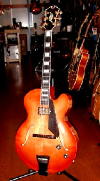
(Note: Mr. Nishimura’s explanation about the guitar)
Surprisingly, this model doesn’t have an official name. If anything, it’s often referred to as the “Electric Hollow” in documents. The “Electric Hollow” you saw recently is an early type made from the late 70s to around 1980. The body was outsourced from Hagström (a Swedish manufacturer, if I remember correctly), but the neck, assembly, and finishing were all done by D’Aquisto. It’s just an ordinary laminated archtop guitar, but it produces an extraordinary sound, which remains a mystery. Many professional guitarists have praised it, with some even suggesting that Jim Hall’s spirit might inhabit it. The tuning pegs were made by Grover, and the pickups were made by Duncan. The one displayed at “Walkin'” is an early model, different from the one Jim Hall uses now. This early type was featured on the album “Circles” and was used during his 1980 visit to Japan. It seems he used it from the late 70s to the mid-80s.
The soft-spoken Mr. Nishimura gave me a key holder from the store’s opening (a rare keepsake) and bid me farewell as we headed to “Full House.”
While talking with Mr. Aoki, we arrived at Koiwa Station, discussing how spending tens of thousands on a guitar that might end up as a decoration would be a waste.
In the report on “Two Days with Wes,” Mr. Sato mentioned being late for the performance and getting confused by the bikes occupying the sidewalk and the hard-to-find entrance. As we examined the route, we agreed it was easy to miss, and opened the narrow half-door. Though the entrance was small, the interior was spacious, with counter seats and box seats on either side. The stage seemed to be at the far end.
I looked around, wondering if the instruments were set up, when I heard, “The master here is a die-hard Tigers fan,” from the side. It was Mr. Matsuzaki, a regular at “Full House.”
Mr. Aoki introduced me, and I greeted him with, “Nice to meet you, I’m Tokui from the Wes Fan Club.” It was a standard greeting, but everything was new to me, so it was all I could say.
“I help out as the Full House resident,” he said, and then introduced Mr. Watanabe, the Full House record keeper. I thanked him for the valuable “OGD” recordings, and he assured me there was nothing to worry about tonight, gesturing with his finger.
I noticed a directional microphone set up on the stage. Mr. Matsuzaki mentioned that the box seats were the best spot for balanced sound, though the stage view was a bit obstructed when the place was full.
The first member of “OGD” to arrive was the drummer, Mr. Yamaguchi. We exchanged business cards and pleasantries. Despite his youth, he showcased his extensive experience and skills honed in America during the performance.
Next, Mr. Makita, a huge Wes fan and renowned automobile artist, arrived. While greeting him and asking him to carve Wes in his fantastic prints, the main guitarist of the day, Mr. Koizumi, appeared. Our conversation shifted to playing techniques and got even more lively. Mr. Koizumi borrowed Mr. Matsuzaki’s Fender Twin Reverb for his performance.
Fifteen minutes before the show, Mr. Takano hurried in with a large setup and started setting up the organ. After brief introductions, it was time for the first set to begin.
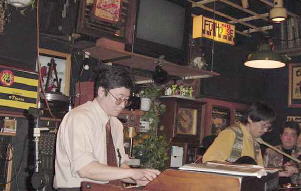
“OGD”: Kiyoto Koizumi (g), Shoichi Takano (org), Shingo Yamaguchi (ds)
“Now, what should we play?” Koizumi-san said, almost as if it were his catchphrase. But he knew well that Aoki-san had already hinted, “With so many Wes fans gathered here today, we have to play Wes, don’t we?” The box seats were nearly full, and later I heard that it was the first full house in a long time. Despite it not being Wes’s anniversary, it ended up being a Wes special.
“Takano-san, nice to meet you. I’m Tokui.” I finally got to meet Takano-san. “Today, a lot of my students came,” he said as I looked around and saw that even the previously empty seats were now occupied, with the waitresses bustling to take orders. “I finally got to see ‘OGD.’ It was exceptional,” I said, though we couldn’t talk much because he had many guests. His versatile technique was a treat to hear.
As I was stuck in conversation about woodblock prints with Makita-san, the second stage began before I could talk to many others. But I was thrilled that he agreed to carve a Wes print for me.
Being naturally shy and not much of a conversationalist, I had told Aoki-san and Koizumi-san in advance, “Please keep it low-key.” Despite this, I asked to take on the role of introducing the members to liven up the atmosphere. Koizumi-san said, “Since you volunteered, please go ahead,” so I took him up on it, though I don’t remember much of what I said. I worried that my sudden intrusion might have bothered the audience, regretting it immediately. But Matsuzaki-san reassured me, “Koizumi-san is on fire tonight, playing some tough techniques.” I agreed, comparing it to past recordings I had received.
After the performance, I asked Koizumi-san, “You were really in the zone tonight, weren’t you?” He humbly replied, “It was just like any other time.” But everyone praised his performance, and I was genuinely excited. The stage ended in a flash, and despite it being past midnight, the excitement about “OGD” lingered everywhere. Suddenly, Matsuzaki-san came over with a message: “This year’s Wes anniversary special is set for June 8. Please come.” I was surprised by how quickly it was decided. “The master is in a great mood because of tonight’s turnout,” he said, likening it to the joy of the Hanshin Tigers winning. “Tokui-san, please make sure to come,” he insisted. “As the fan club president, you should visit Tokyo at least once a year,” he added, nudging me. “I’ll definitely come,” I promised, noticing the normally stern master’s smiling face. I jokingly said, “I’ll bring some Tigers merchandise next time,” and the conversation shifted to baseball, eventually wrapping up as people headed home.
After this, Koizumi-san was to participate in an all-night jam session at “MANHATTAN” in Asagaya as a bassist. Takahashi-san, a fan of Koizumi-san, and I decided to go together. Although I would return to Osaka tomorrow, I wanted to hear his bass playing since I had nothing else to do but sleep at the hotel. It turned out to be a great plan. The owner of the small club near the station, which could only hold about ten people, played the accordion, and Koizumi-san introduced us. Musicians came and went for two songs at a time, making it feel like there were more musicians than audience members.
An hour later, more musicians arrived, creating a sardine-packed, oxygen-deprived environment until around 5 a.m., when it was hard to move at all. It was a mix of professionals and those still learning, emphasizing the need for such places. Unlike Kansai, where such opportunities were scarce, I felt bad for the aspiring musicians there. After sipping dawn coffee, I parted ways with Koizumi-san, who guided me to the first Tokyo-bound train, ending my youth-filled adventure.
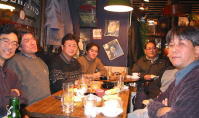
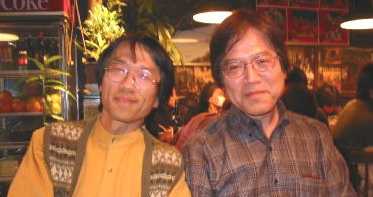

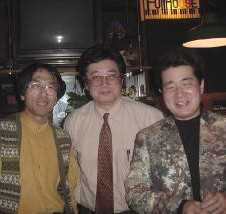
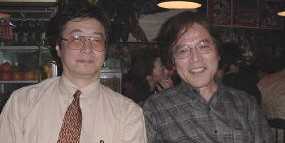
I sat on a bench at the station, basking in the fulfillment of my trip. I was glad I came to Tokyo. I visited the long-desired landmark, met the members of “OGD,” the regulars at “Full House,” and even Sugimoto-san. Most of all, I’m grateful to Yokohama correspondent Aoki-san for all his help. “Thank you,” I said, feeling his exhaustion. I look forward to seeing everyone again.