
Wes’s Guitar
Edited 2020/9, 2023/9
The Montgomery sect surpassing the Christian sect.
To begin with, the establishment of modern jazz guitar as we know it today can be attributed to the genius guitarist Charlie Christian, who, in 1936, switched to the archtop “ES-150” model by Gibson, the first electric guitar equipped with a pickup, released the following year. He swiftly and boldly mastered this guitar, effortlessly revolutionizing the jazz guitar world and paving the way for his legendary status.
Christian, who fused gypsy music with jazz during his time, apart from Django Reinhardt, was also popular for his melodious solos. Influenced heavily by Lester Young, he shattered conventional norms by playing horn-like solos with single notes, further innovating sound and chord change techniques. Not only did he influence the direction of jazz guitar, but his improvisation also significantly contributed to the emergence of bebop.
Why was he a genius? Firstly, he gained fame in 1939 when the distinguished producer John Hammond discovered him and recruited him into Benny Goodman’s combo. With his fresh phrasing, he quickly gained the spotlight, achieving these feats in the few years before his death from pneumonia in 1942.
He is revered as the “pioneer of modern jazz guitar” due to these accomplishments.
Another significant figure is Les Paul, originally a country guitarist who began developing his own pickups around 1930 and eventually collaborated with Epiphone to complete the “Log” model. His popularity soared when he showcased this model on radio programs. Not only did he develop pickups, but he also pioneered effects such as delay, echo, reverb, and multi-track recording techniques. His curiosity led Gibson to commercially release the Les Paul model in 1952 (though he had been using a prototype since 1941), making significant contributions to the jazz guitar world.
Around 1945, influenced by Charlie Christian, various guitarists emerged, such as Barney Kessel, Jimmy Raney, and Herb Ellis, later collectively known as the “Christian sect.” They solidified the guitar’s indispensable position in jazz. Charlie Christian was universally acknowledged as a genius guitarist due to his unprecedented octave technique, which left music aficionados, musicians, and jazz fans in awe upon his scene debut in 1959, endorsed by Cannonball Adderley and produced by Orrin Keepnews.
He captured immediate attention by winning the New Star Award in Down Beat magazine’s 1960 popularity poll and firmly secured first place in the international critics’ guitar category the following year.
His octave technique, comparable to Christian’s achievements, or even surpassing them, exerted significant influence, posing a formidable threat to active musicians at that time. Personally, I would argue that if Charlie Christian is the “founder of modern jazz guitar,” then Wes Montgomery is the “founder of octave technique.” In other words, despite Christian, technician Faurou, and even dedicated researchers like Paul, the octave technique, which was something that Django Reinhardt was said to have used in advance, suffered a fire accident. Because two fingers are not free in the state, left hand forms are different and peak sounds It is different from Wes’s own thing to distinguish clearly) made how big jazz guitar, no, it contributed to today’s jazz world, if a guitarist of any genre inherited, its technical use That’s why he can be recognized as “Wes Montgomery sect”.
Wes’s beloved guitars
Wes’s first guitar, according to his brother Monk, was a tenor guitar he found in a pawn shop in 1935 (there are also claims it could be 1934). Wes wanted it badly, so he saved up $13 from odd jobs to buy it. This was a significant amount during the Great Depression, when Wes was 12 years old. Based on the timeframe, the guitar was likely a tenor version of the Gibson archtop L-50, known as the ‘TG-50,’ which was manufactured and sold from 1934 to 1957.
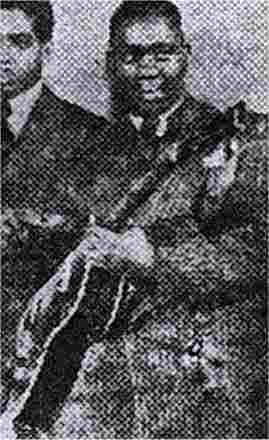
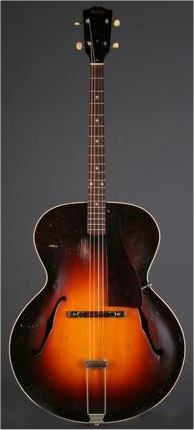
Left in the photo… November 1944, backing for the local R&B band The Four Kings and A Jack. Wes, still unknown as a guitarist, performed at the Ramboogie Club on Indiana Avenue.
According to reports, in a newspaper advertisement photo from that show, Wes appears with what seems to be a four-string tenor guitar. The guitar in the photo has aftermarket pickups and controls installed.
On the right is a 1939 Gibson TG-50, but it is believed Wes bought a used model from 1934-35, similar in type.
So, it’s legendary that Wes Montgomery’s first six-string guitar purchase was the Gibson “ES-150 Charlie Christian Model.
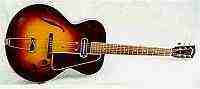
From 1936 to 1939, the Gibson “ES-150” shipped from the Gibson factory in Kalamazoo, Michigan, featured a distinctive hexagonal design with a single-bar pickup (commonly known as the CC pickup) mounted on it. It gained popularity when used by Charlie Christian, leading to it being referred to as the Charlie Christian model since 1939.
Starting from around late 1939 to 1943, some improvements were made to the Gibson “ES-150” guitar. It transitioned to feature the “P-13” pickup, which had an Alnico magnet and six adjustable pole pieces, a precursor to the later “P-90” pickup. During World War II, production was interrupted, but from 1946 to 1956, Gibson resumed sales with a new model. This updated version included a switch from the “P-13” to the “P-90” pickup, an increase in body size from 16 inches to 17 inches, and enhancements in materials and decorations, making it a more luxurious instrument.
Let’s consider the 6-string guitar that Wes first bought. According to Adrian’s account, “Wes bought a 6-string guitar and an amplifier for $350, practiced Charlie Christian’s style for about 8 months, and by the time he turned 20, he was performing at the 440 Club.” This suggests he purchased the instrument around mid-1942, before marrying Serene.
In fact, in a 1961 interview with Ralph Gleason for DownBeat magazine, Wes mentioned, “I started playing music after I got married, and bought a guitar and amp about 2-3 months later.” This places the guitar purchase around mid-1943.
However, Wes himself didn’t mention buying it for $350 in the interview. In an unpublished Montgomery Brothers book, Buddy reminisced, “I bought a more expensive guitar and amp for $300,” suggesting that Wes’s first 6-string guitar and the $300 guitar he bought later were different.
It’s been traditionally said that Wes’s first 6-string was the Gibson “ES-150” Charlie Christian model, but there’s no confirmation of this. In “Indianapolis Jazz/The History Press 2014,” I found the following account:
“During World War II, guitarist John Blanchard served in the U.S. Army and undertook special duties as an entertainer. After the war, he returned to Indianapolis, where he continued his performance career at venues like P&P Club at 438-1/2 Indiana Avenue. He humorously recalled an incident at a club: ‘A young man came in with an ES-125 guitar, missing one peg and carrying pliers to tighten the strings. He placed the guitar beside the stairs and carefully watched me finish my first set.’ During intermission, the young man approached Blanchard and introduced himself, confessing, ‘I’ve been listening to you play two octaves, but I don’t know how you do it. Could you teach me?’ Blanchard kindly taught chords to the young Wes Montgomery.”
If Blanchard’s story dates back to 1945, Wes was indeed a 22-year-old young man. The story of him purchasing a 6-string ES-125, whether new or used up to the 1942 model (production halted in 1943 due to the war), fits logically. However, questions remain about whether Wes bought a rear-mounted pickup guitar, considering the fact that the ES-125 model’s single pickup was rear-mounted until it was reproduced in 1946 with a front-mounted P-90 pickup. Despite these uncertainties, the information remains highly credible, as even a used 6-string guitar would have allowed Wes to practice effectively, especially as a newlywed with limited funds for a $300 purchase.
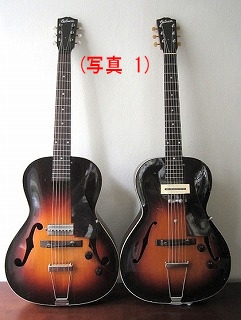
The predecessor of the ES-125 seen on the left side of (Photo 1) was released in 1938 as the Electric Spanish (seen on the right side of Photo 1) under the name ES-100. The name ES-100 stemmed from the pricing strategy: the guitar and case set was priced at $55, while the EH-100 amplifier was also $55, totaling $110. However, when sold as a set, the price was reduced to $100, hence ES-100.
On October 1, 1940, shortly after Gibson advertised the new EH-100 in their catalog, the price was raised, and the set was sold for $125, resulting in the renaming to ES-125.
The earliest definite period when Wes is seen with a guitar can be pinpointed to his tenure with Lionel Hampton from 1948-1950 (ages 25-26) (Photo 2). The guitar he is holding appears to resemble a 1946 model with a mahogany neck, a 17-inch body size, a script logo head of the Electric Archtop ES series released since 1940, a tailpiece designed with f-holes, a single-bound tortoiseshell pickguard, and transparent speed knobs, equipped with a “P-90” specification (Photo 3).
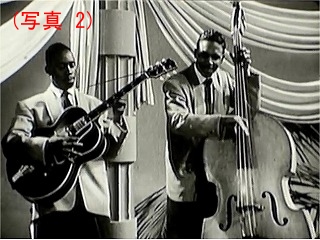
Supported by Monk’s testimony, it appears that Wes gained financial stability after a long tour with Snooky Young and others in 1946. This period might have enabled him to purchase the “ES-300.” In Gibson’s 1940 catalog, the standalone price for the “ES-300” guitar was $160, and the “EH-275” amp was $125. The set price including guitar case and accessories was $300. However, photos from Hampton’s orchestra show a Fender “Dual Professional” amp, suggesting they might have been purchased separately.
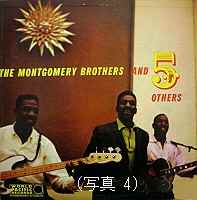
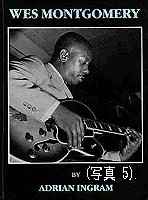
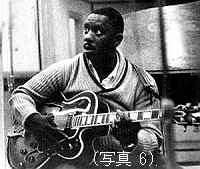
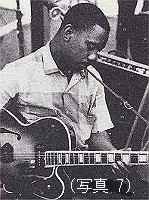
A clear image of Wes holding a guitar was captured in 1957 (age 34) on the jacket of the Indianapolis recording “The Montgomery Brothers And 5 Others/World Pacific PJ-1240,” featuring an “L5CES Venetian Cutaway Sunburst Finish” guitar (Photo 4). This guitar can also be seen on the cover of Adrian Ingram’s book “WES MONTGOMERY” (Photo 5) and in performance scenes at the “500 Room” in various insert photos. It was used in recordings such as the 1960 “Movin’ Along/Riverside RLP-342” (Photo 6) and on the back cover of the 1961 “George Shearing And The Montgomery Brothers/Jazzland JLP-55” (Photo 7), likely recorded with the “L5CES Venetian Cutaway.” Note that the guitar’s front pickup has varied between using Alnico V (originally standard) and being replaced with a P90, but it’s the same guitar model.
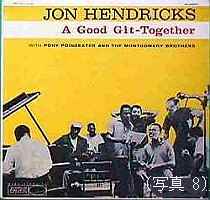
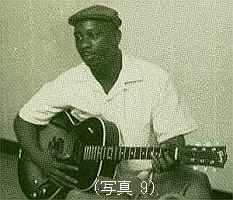
Next, in 1959 (at age 36), Wes used the “ES-125D” guitar for accompaniment with Jon Hendricks on “A Good Git-Together/Jon Hendricks/World Pacific WP-1283” (Photo 8). This guitar is prominently featured in clear photos in Ingram’s book “WES MONTGOMERY” (Photo 9).
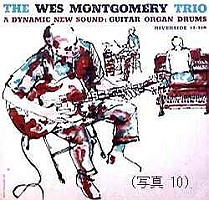
In the illustrated jacket of “The Wes Montgomery Trio/A Dynamic New Sound/Riverside RLP 12-310” (Photo 10), the guitar depicted cannot be identified specifically, but legend has it that it is a custom-made “L-7C” borrowed from Kenny Burrell.
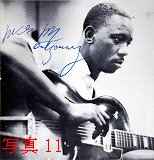
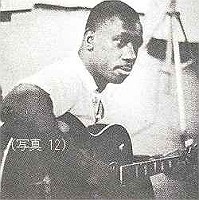
The photo on the back jacket of “The Incredible Jazz Guitar of Wes Montgomery/Riverside RLP 12-320” (Photo 11) was taken during recording in NYC. It features a custom-made guitar, likely with Charlie Christian type pickups and a 17-inch body. The body lacks binding around the f-holes, but binding runs from the neck to the headstock, and the guitar features pegs and a tailpiece in “L-7” specifications. The fingerboard has block inlays, which suggests it may have been fitted with a fingerboard from an “ES-5” or “L-5” model, a common practice in custom-made guitars.
Incidentally, the back jacket of Cannonball Adderley’s “Cannonball Adderley And The Poll-Winners/Riverside RLP-355” (Photo 12) features the same photo.
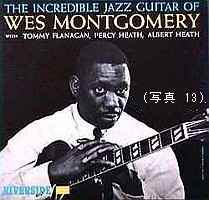
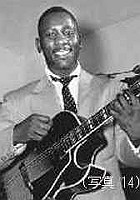
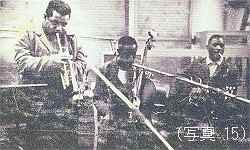
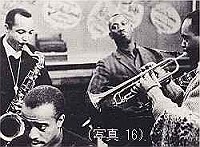
And the photo on the front jacket (photo 13) of 1960 (age 37) 《The Incredible Jazz Guitar of Wes Montgomery/Riverside RLP 12-320》 is an “ES-175″ with a P90 pickup, 16”, The parallelogram and its features can be seen. It could be an “L-4,” but it is more likely to be an “ES-175” because it is equipped with a pick-up. (Photo 14: If a pick-up was added later, it might be an “L-4,” but it is difficult to make an absolute distinction from the photo, as the top board material is different. 15) “West Coast Blues/Harold Land/azzland JLP-20” with Harold Land (Photo 16), and the aforementioned “Cannonball Adderley And The Poll-Winners/Riverside RLP-355” with P90 pickup. The sound of the P90 pickup can be confirmed.
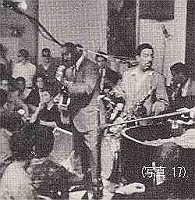
Wes’s second “L-5” venture was the “L5CES Florentine Cutaway,” and his initial recording with it was in 1962 (at age 39) on “Full House/Riverside RLP-434,” evidenced by the live scene on the back cover (photo 17). The pickup used was a PU-490, commonly referred to as “PAF,” conveying a crisp sound that’s truly delightful.
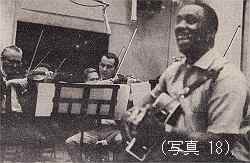
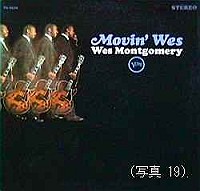
This guitar was also used in other recordings, including in 1963 (at age 40) on “Boss Guitar/Riverside RM-459” and “Fusion!/Riverside RM-472” (photo 18), Riverside’s last two releases “Portrait of Wes/Riverside RM-492” and “Guitar On The Go/Riverside RM-494,” and personally, Wes’s favorite initial recording at Verve in 1964 (at age 41) on “Movin’ Wes/Verve V6-8610” (photo 19).
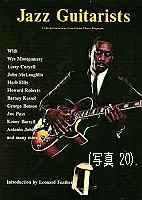
Up to this point, the “L5CES Florentine Cutaway” (photo 20) had been used in six albums, clearly becoming one of Wes’s favorite guitars.
Currently, there is information about the ownership of this guitar. The latest story I’ve heard is that the current owner is George Benson, who had been trying to acquire one of the four “L-5” guitars that Wes owned. It seems that after Wes’s death, Thelma, his wife, parted with this guitar for some reason. Two years later, George Benson finally managed to acquire this “L5CES Florentine Cutaway,” although it’s unclear whether he purchased it privately or from a dealer.
The case has a black alligator-style pattern, and while the parts are Gibson, it’s uncertain if they are original or something Wes found somewhere. When obtained, the condition was not great—thin nitrocellulose lacquer finish in Tobacco Sunburst, with corrosion evident. This affected the tuning pegs and tailpiece, yet despite these issues, the sound quality was reportedly excellent.
A significant damage point was an old crack and a large hole near the jack on the neck side, with worn-off lacquer around the rim, prompting repairs by Gibson. Curiously, an article by Seito Koizumi in “The Tracks of Great Masters/Wes Montgomery,” published by Rittor Music, mentions the ownership of this guitar. As of 1992, it was stated that guitarist Jerry Byrd owned it… Later passing to Benson, it’s unusual for a guitarist to let such a valuable instrument deteriorate to such a state. One can’t help but wonder if there might be two of these guitars, but that’s a thought no one wants to entertain.
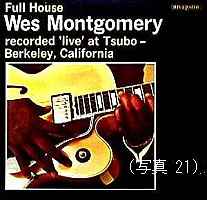
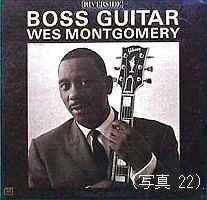
Regarding the front covers, it’s been repeatedly explained that the “L-5 Natural” seen on the covers of “Full House/Riverside RLP-434” (photo 21) and “Boss Guitar/Riverside RM-459” (photo 22) were taken for Gibson promotional purposes and were not actually used in recordings.
After 1965 (age 42), further explanations may seem unnecessary, but Wes’s third “L-5,” a custom-made one with a heart inlay made specifically for him, made its debut during a European tour (photo 23). It appears that Wes used this heart-inlay “L-5” for Verve recordings following the album “Bumpin’ /Wes Montgomery/Verve V6-8625”.
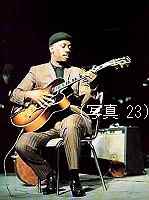
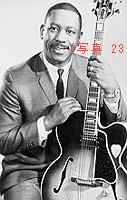
Upon reflection, it’s speculated that this guitar, said to be gifted by Gibson, was possibly made specifically for this tour. This heart-inlay “L-5” was used at the Newport Jazz Festival in June 1967, and it seems Wes switched to the guitar I’ll mention next shortly after this June.
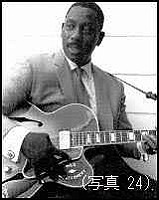
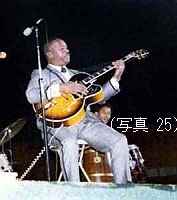
That guitar is the fourth “L5CES – Custom Made,” following the heart-inlay “L-5,” featuring distinctive diamond inlays (photo 24). This so-called diamond “L-5” was from 1967 (age 44) after Wes moved to A&M, reputedly donated in response to the success of “A Day In The Life/Wes Montgomery/A&M SP-3001” (photo 25), marking his final guitar.
It’s said that Wes’s grandson has owned this guitar since 1998.