
YESTERDAYS (Transcribed by GIBSON BOY)
This time, we have transcribed Wes’s improvised solo from “YESTERDAYS” featured in the 1994 VAP release that thrilled fans with its astonishing VTR and the moving image of Wes in “JAZZ625”. (For more information about “JAZZ625”, please refer to the album-specific introduction section on our site.)
Wes performed this song on the Riverside recording of the WES MONTGOMERY TRIO (RLP12-310) in October 1959, marking his effective major debut. The performance feels somewhat fresh and naive. One can sense the tension of moving from Indianapolis to the bustling NYC and recording there.
In “JAZZ625”, Wes, now an established top jazz guitarist, performs with a commanding presence and refined technique, brilliantly interpreting this Jerome Kern classic in his own language. The phrases in the minor pattern IIm7–IIIm7♭5–V7alt are particularly moving.
Additionally, Wes’s technique of breaking down V7 into IIm7–V7 and his simple yet rational use of fourth progressions in octave solos are impressive. One is left in awe of how Wes can improvise and make such musical choices so effortlessly. Wes is truly a genius of improvisation.
In this publication, we present the Melody Statement from the Riverside version and the improvised solo transcribed from “JAZZ625”. An analysis of the ad-lib solo is also included, revealing Wes’s thought process.
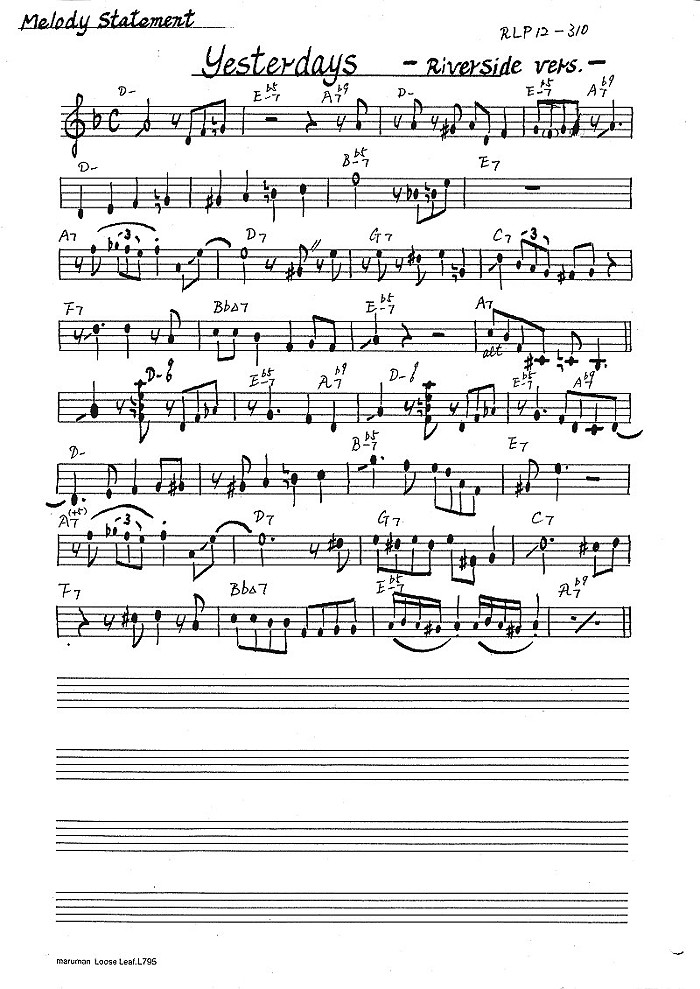
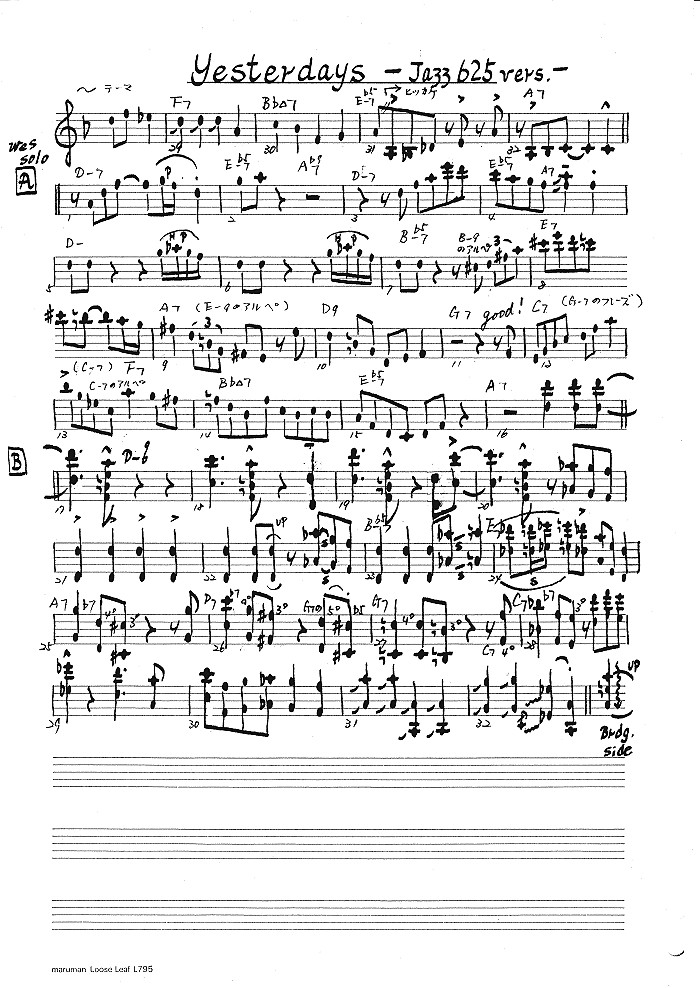
[Wes Ad-lib Solo Analyze] (From the 625 Version’s Score)
Before entering the ad-lib section from the theme:
- Bars 31–32: The phrase leading into Dm is an effective “hook” that creates a sense of “Here we go!” Wes skillfully uses open strings.
[A]
- Bars 1–7: Minor pattern phrases, very stylish and impressive. Especially bars 3–5 feature double stops in an excellent phrase.
- Bars 7 (3rd beat)–8: Bm7♭5–E7 with Bm9 arpeggio (Wes often handles m7♭5 or m7 similarly). Moving to the next:
- Bar 9: A7 is considered as IIm7–V7, with Em9 arpeggio. A signature Wes phrase.
- Bars 12–15: This section features a very impressive phrase. C7 is considered as IIm7–V7 with Gm phrases, and the connection to F7 in bar 13 is calculated with Cm7 arpeggio phrases following the chord progression.
[B]
The final chord is Dm69, played from the 1st string upwards, with Wes emphasizing a hard, impactful sound from the bridge side of the guitar.
Bars 17–20: Counterpoint with octave technique and chords (Dm69) for a rhythmic effect.
Bars 21–23: Centered around the D (T) note, creating a 4-beat swing feel with quarter notes. The use of octaves adds to the effectiveness.
Bars 25–28: After Bm7♭5–E7, the progression to A7, D7, G7, C7, a fourth progression of V7, is skillfully handled. Using ♭7, 4°, 3°, 5° notes similarly, the V7 fourth progression is crafted with great finesse.
GIBSON BOY