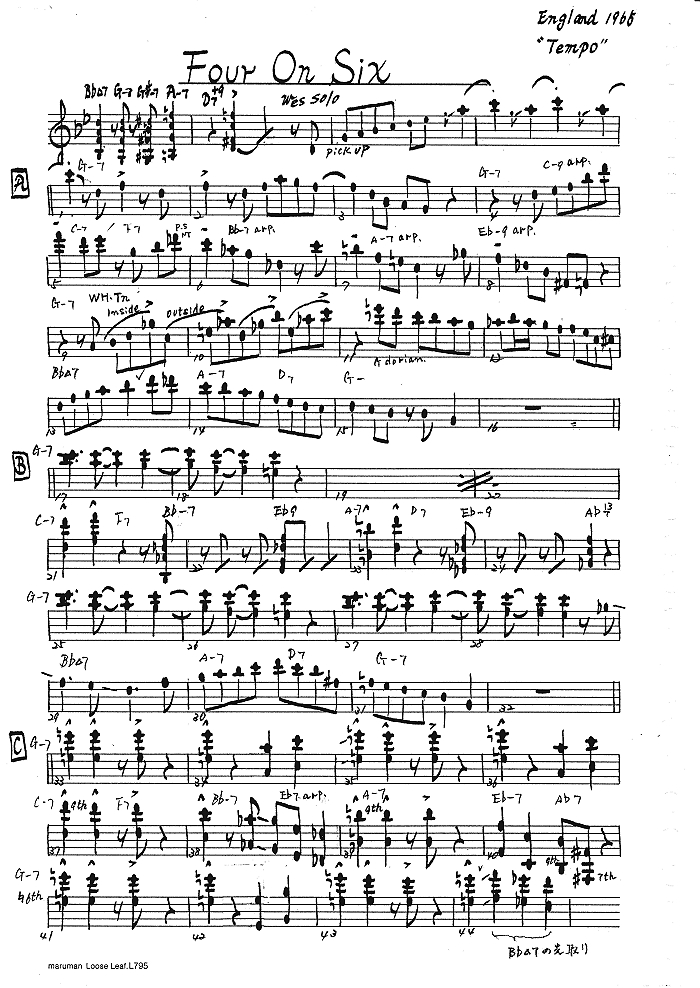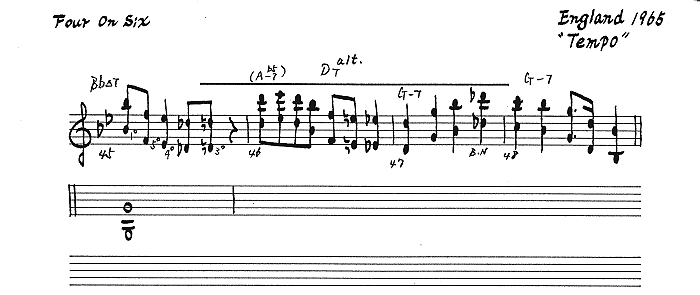
Four On Six(Transcribed by GIBSON BOY)
Currently, among Wes fans, the third installment of “Moving Wes,” Wes Montgomery Live In ’65/Jazz Icons (for more details, please see News Flash No. 87 on this site), is creating quite a buzz. This is because two previously unreleased videos have been released. The so-called achievements of Wes’s 1965 European tour have already been sensationally introduced to jazz and Wes fans through records and videos. The Wes Montgomery Live In ’65 is exactly the same in this regard.
Among the many intriguing videos in this collection, the special angle of the guitar performance in the “Four On Six” video is of particular interest to guitarists. This video also marks the first time Wes’s iconic composition and signature piece “Four On Six” has been captured on film. Hence, this time, we present the transcription and analysis of Wes’s ad-lib in his representative masterpiece “Four On Six” from the “Tempo” segment of Wes Montgomery Live In ’65.
As a side note, there are various interesting stories about the origin of the title “Four On Six.” These are also covered in Blog No. 35 on this site, so please read it as well.
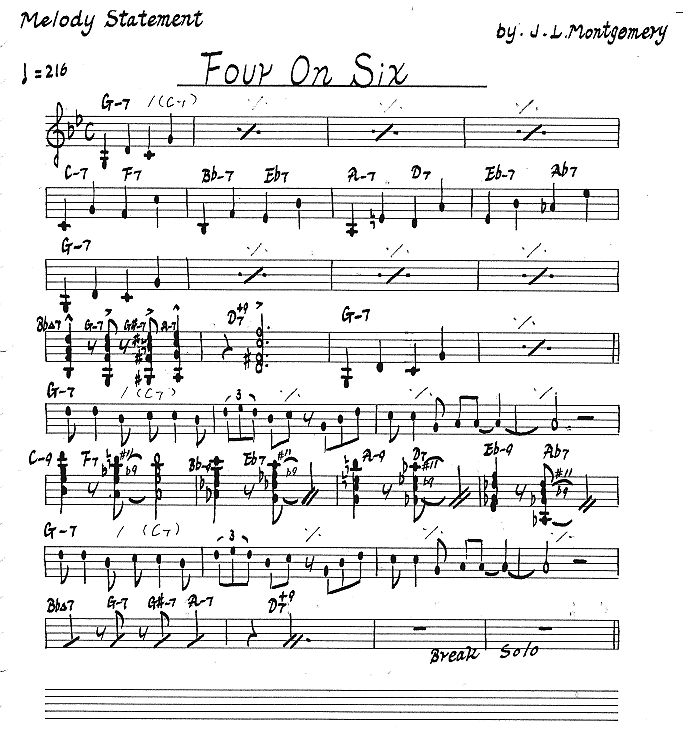
Analysis The structure of “Four On Six” is in A-B-A-C form, with 4 bars x 4 = 16 bars making up one chorus. The chord progression is the same as “Summertime,” and it was composed based on this. The distinctive guitar and bass phrase at the beginning of the theme is said to have originated from Monk Montgomery’s performance in “Summertime” during the recording of Montgomeryland/PJ-5 in 1960.
In a broad sense, the chord progression can be understood as follows: in G minor, the “A” part is a straightforward Gm for 4 bars, the “B” part features a series of II-V patterns, changing chords every bar (Cm7 – F7 / B♭m7 – E♭7 / Am7 – D7 / E♭m7 – A♭7). (This chord change sequence is really cool! It’s great practice for detailed II-V changes.) The “C” part consists of B♭Maj7 from the parallel key, followed by Am7-5 – D7alt / Gm / Gm, forming a minor II-V cadence.
Ad-lib Analysis Let’s analyze Wes’s solo in detail using the ad-lib transcription. The pickup solo at the beginning break can be closely observed in the video, showing how he uses his right-hand thumb for up and down strokes.
“A” (rehearsal mark A) 4 bars: Here, he anticipates the next measure’s Cm9 arpeggio, leading into bar 5. The D♭ note on the offbeat of bar 5 acts as a passing tone, transitioning into the B♭m7 arpeggio in bar 6. The use of notes here is truly remarkable. The arpeggios used in the II-V chord changes from the offbeat of the 4th bar through bars 5, 6, 7, and 8 (Cm7 – F7 / B♭m7 – E♭7 / Am7 – D7 / E♭m7 – A♭7) are outstanding.
Bars 9-10: A phrase using the C whole tone scale over Gm7. Wes frequently uses this phrase. To explain why the C whole tone scale (Cw.T.) works here, consider Gm7 as Gm△7 with the notes G, B♭, D, and F♯. Playing Cw.T. makes the initial notes B♭, D, and F♯ fit inside the Gm7 sound, while the subsequent notes C, E, and A♭ are outside notes. This alternation between inside and outside notes creates a surprising effect. This reveals a bit of Wes’s thinking regarding tonic minor. Thus, the whole tone scale can be used for tonic minor or directly for V7. In “If You Could See~,” Wes uses the D♭ whole tone scale similarly for D♭7. Listen to it once.
“B” (rehearsal mark B) bars 17-20 and 25-28: In both Gm7 sections, the use of top notes on C and descending Gm scale tones creates an impactful and interesting sound.
Bars 29-31: In the C section, the phrase perfectly fits the cadence ♭III△7 – IIm7-5 – V7 – Im7, serving as an exemplary phrase.
“C” (rehearsal mark C) starts with octave technique, creating a percussive impact.
Bars 33-36 and 41-43: Both in the Gm7 sections, the use of the natural E (VI) in octaves, percussively, possibly reflecting a Dorian mode or melodic minor idea, though it feels slightly unconventional, sounds remarkable.
Bars 44-49: From the second beat of bar 44, a phrase anticipating the B♭Maj7, beautifully sings through the ♭III△7 – IIm7-5 – V7 – Im7 cadence to the end of bar 49.
GIBSON BOY