
“Black Magic Wes” Santana?
When asked about Carlos Santana, the reigning giant of the rock world, what comes to mind for me is “Black Magic Woman”. His debut came in 1969, just after Wes Montgomery’s passing, and the following year, this song became a huge hit. Based on samba-infused blues, I vividly recall the sound of his sustain-laden, dry guitar and the tingling of the timbales, wearing out the needle on the single as I listened repeatedly.
I also remember the term “Latin rock” being coined around him, wasn’t he one of the pioneers? My musical tastes have always started with Latin, but it was the fusion with rock that really captivated me for a while… And his technique, with a hint of jazz atmosphere, was particularly appealing.
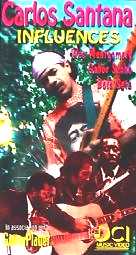
It’s said that Santana was greatly influenced by three guitarists, a video of his own explanation and performance, released in 1995. I happened upon it by chance at a music store in Sannomiya, piled up and seemingly unsold. It wasn’t a Santana music video as such, but rather an explanation of the playing styles of three guitarists who influenced him, demonstrated in part by imitation, which didn’t quite catch on with the general public.
This video, released by Yamaha Music Trading, which secured distribution rights from DCI Music in America, not only features Santana’s explanations of the three guitarists who influenced him, but also includes footage of Wes Montgomery from BBC Jazz 625 and a couple of previously unseen photographs. However, musically, there were no groundbreaking discoveries. Here’s a quote from Santana about his interest in Wes:
“I want to introduce three musicians who have had a significant influence on me: Bola Sete, Gabor Szabo, and Wes Montgomery. Each of them has a diverse range of expression that inspired me. They learned from traditional and folk music, integrating these influences. Their sound combines the wisdom of their predecessors, incorporating styles from Charlie Christian and Django Reinhardt to Paco de Lucia.
Starting with Bola, I think of him as the Afro-Brazilian Segovia. His talent and dexterity are on par with Jimi Hendrix’s. Before listening to Gabor, I was immersed in B.B. King, but over time, I discovered Gabor and Wes. I can still learn from them today, but it was Gabor who first caught my attention. Until then, I only had eyes for B.B. King; I was completely absorbed. Gabor showed me the potential of the guitar, nurturing my ears to appreciate its simplicity and beauty.
I think it’s important to look inward at oneself. First, find someone who inspires you, then break free like a snake shedding its skin. It’s about finding your own sound, moving away from influences absorbed from others. Initially, absorb from others, then find yourself.
Wes Montgomery’s sound… it’s like the warm embrace of a loving father. Bill Graham described it as a very paternal sound. It’s deep and comforting. When feeling down or even contemplating suicide… listening to Wes’s music can suddenly calm you down, trivializing your troubles.
His sound is so distinctive, it can’t be imitated. Wes Montgomery is noble. He elevates everyone who listens to him, transforming even a dive bar into a royal palace when you close your eyes and listen. His music is sophisticated and ever-evolving. He’s our Beethoven, like Duke Ellington. Mozart exists in Europe, but we have Wes here. Their influences, like B.B. King, Lester Young, Coleman Hawkins, are apparent, yet they’ve carved out their own unique worlds.
Eric Clapton imitated Freddie King and Albert King, but never lost his individuality. Bola, Gabor, and Wes created new styles. They’re masters who can convey their emotions through a single note, expressing a sublime world.
Through this video, I’m happy to share their philosophy and approach with young people. Our goal isn’t just to boost sales; it’s about piercing people’s hearts with our philosophy and approach. Our aim is to move and touch people with heartfelt music.”
Reference: Carlos Santana / Influences
Yamaha Music Trading LDC13031
VHS-STERO 60 mins Japanese subtitle edition